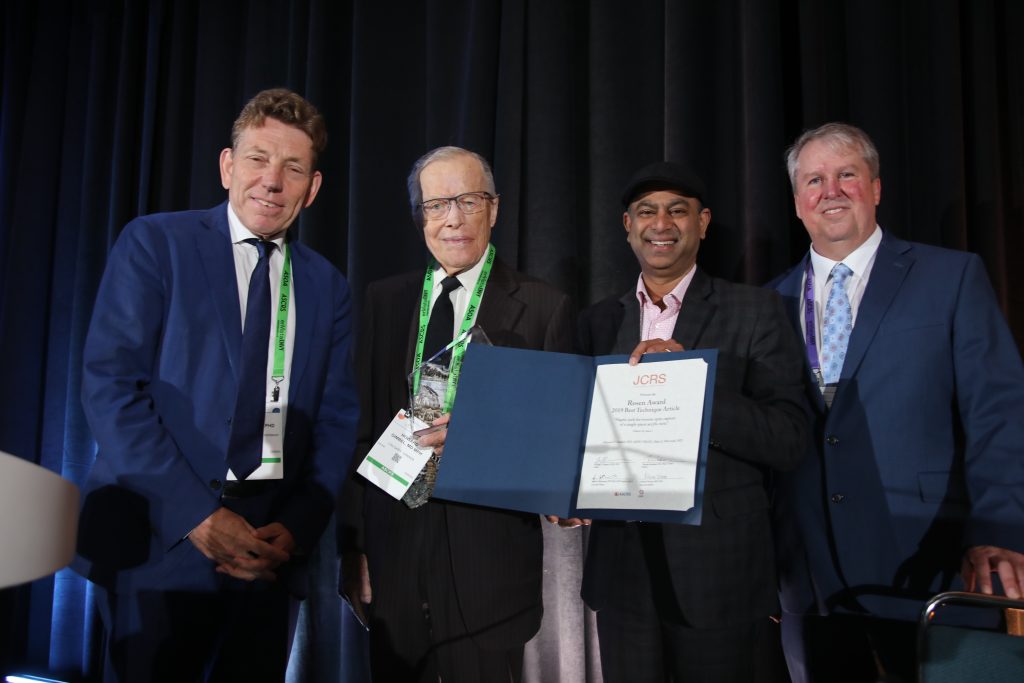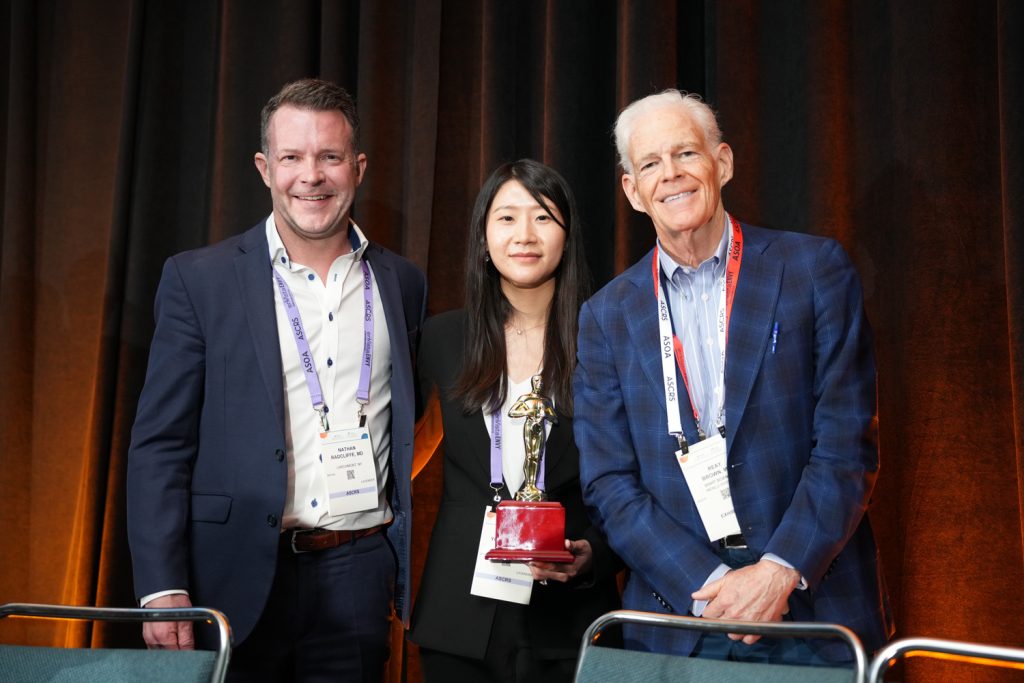
Phaco with the Stars was a new session at the ASCRS Annual Meeting based on the concept of the TV show Dancing with the Stars where a professional dancer is paired with an amateur. In this symposium moderated by David Chang, MD, six anterior segment fellows presented complicated cases that were managed with the advice and guidance of their fellowship directors.
In three different categories, two teams competed against each other with the winner voted on by the audience.
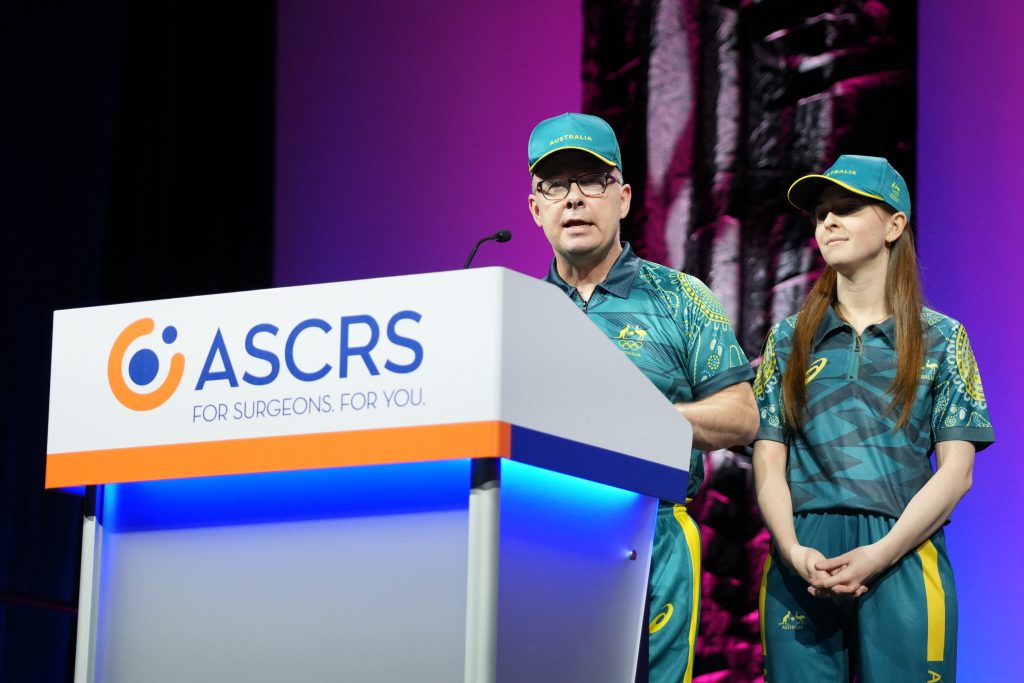
In the category of Complex Cataract, fellow Abigail Harrover, MD, with her director Mitchell Weikert, MD, competed against fellow Aaron Dotson, MD, and director Julie Schallhorn, MD.
Team Harrover/Weikert’s case involved a 56-year-old male referred for cataract surgery OU. In one eye, he had a history of BB gun injury at age 9. His vision was only “slightly” worse after this injury. He also had a history of PDR OU s/p PRP and traumatic glaucoma OD.
Source: ASCRS
Dr. Harrover took the audience through the case where she marked the locations to optimize real estate, aimed the paracentesis blade toward the pupil edge, aimed the next iris retractor toward the prior in order to engage, enlarged the pupil, painted with trypan under OVD, rotated the nucleus toward the area of zonular weakness using two instruments, used a chop technique working centrally, filled with OVD before removing irrigation, used a second instrument for manual CTR insertion with a Sinskey hook to prevent stress to the capsulorhexis edge, and rotated the iris retractor up for safe removal.
At this point, Dr. Weikert said Dr. Harrow did great. But this was just the phaco portion, now we have to deal with the iris, he said, which required three different techniques to repair. The pearls the team provided for the iris repair of this case included: use a trocar to facilitate needle passage in iridodialysis repair; dock the suture needle into a 27-gauge needle for an ab externo approach; remove the docked needle before externalizing for better control; eliminate the peaking pupil with the single-pass four-throw pupilloplasty technique; and round out the pupil with some additional intraocular cautery.
This section’s co-judges, Sri Ganesh, MD, said the case was “very well done,” and Bruno Trindade, MD, said he applauded the pre-planning that went into this technique.
The next team, Dotson/Schallhorn, shared a case of cataract and corneal opacity. The case involved a 36-year-old female who had increasing difficulty with glare (unable to tolerate any point source of light) and anterior subcapsular cataracts. She had a history of Peter’s anomaly OU, deprivational amblyopia, and irregular astigmatism. The anterior subcapsular cataract was small but under an already small pupil and visually significant, and Dr. Schallhorn said there was a whole area of iris synechiae that were tented up under the area of Peter’s anomaly.
Dr. Schallhorn said it’s important to have a game plan. The biometry/target would be a challenge due to the corneal scar, as would the visualization and the synechiae. Because the patient had irregular astigmatism and a long axial length, the team targeted the patient for –2, knowing she would have a scleral lens after surgery.
You have to be set up for success in these complex cases, Dr. Schallhorn said. Some of the keys for success she gave were to block the patient so they would be comfortable, ensure a good trypan stain, use iris expansion devices, maximize lighting for the best possible view, and leave the synechiae if they were adhered to the cornea because you could do more damage if trying to cut them out.
From here, Dr. Schallhorn had Dr. Dotson present the case. As he began to make the paracentesis in the video, Dr. Schallhorn quickly paused it. Dr. Dotson is left handed, she said, then providing several tips for helping train a left-handed trainee.
Back to Dr. Dotson, he showed various steps he took to get the best visualization possible in this case, freeing some of the smaller synechiae strands and placing iris hooks in a fairly asymmetric manner due to the synechiae/scar. Once as much visualization possible was achieved, Dr. Dotson performed routine phaco. There were instances where visualization in the area of synechiae prevented a clear view. At this point, Dr. Dotson said you had to “step out on faith” and trust yourself. The case proceeded with insertion of a 3-piece lens.
The learning points for complex cases such as this, Dr. Dotson said, are to use the tools you already know, engage in significant prior planning and practice, and have the right coach/mentor.
Dr. Trindade said the team did a great job, and Dr. Ganesh shared that he might have used UBM to know the extent of the synechiae. He also said that he would assess the patient’s visual axis preop and might perform a pinhole pupilloplasty during the case, centering the pupil on the marked visual axis.
The audience voted for the team that taught them the most. The winning team was Team Harrover/Weikert.
Financial disclosures
Chang: Alcon, Centricity, ForSight Visio 6, Johnson & Johnson Vision, RxSight, Zeiss
Dotson: None
Ganesh: Biotech Vision Care, Hoya, Medicel, Zeiss, Ziemer
Harrover: None
Schallhorn: AbbVie, Forsight V6, Johnson & Johnson Vision, Zeiss
Trindade: None
Weikert: Alcon, Zeiss