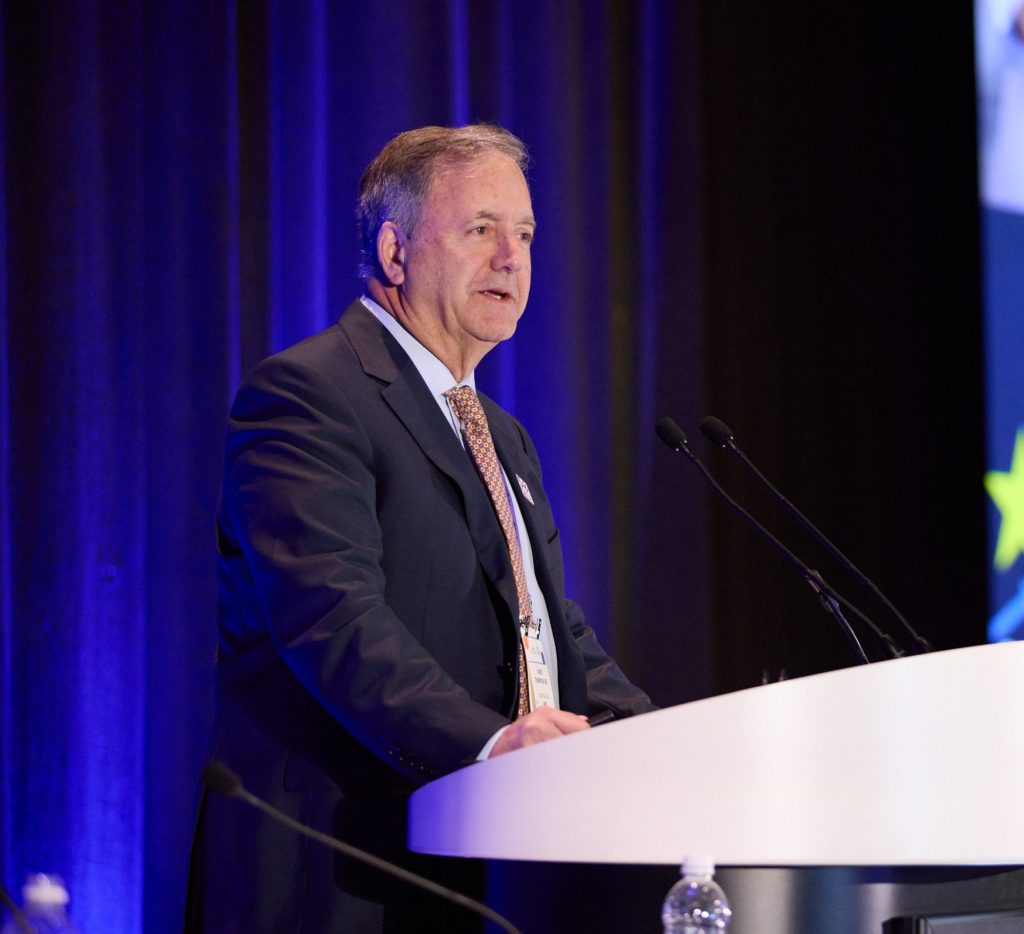
The ASCRS AGS Joint Symposium on Friday, April 25, during ASCRS Glaucoma Day featured presentations on the landmark trials that have taken place during the MIGS revolution.
Ticiana De Francesco Figueiredo, MD, discussed the HORIZON trial, which she called “one of the highest quality, long-term MIGS studies.” This trial evaluated the outcomes of Hydrus (Alcon) and phaco vs. phaco alone. After a medication washout, the mean diurnal IOP of participants was 22–34 mm Hg. Patients were randomized 2:1 into the Hydrus plus phaco group (n=369) vs. phaco alone (n=187).
After 5 years, which saw 80% completion among participants, Dr. Figueiredo reported that the Hydrus group had more eyes at 18 mm Hg or less than the phaco-alone group. The Hydrus group also had more eyes achieving this IOP without medications, and it was also more likely to achieve a 20% reduction in IOP or more without medications.
From a safety standpoint, at 5 years there was no difference in endothelial cell loss among the two groups. Eyes treated with Hydrus were 2.8x less likely to need a secondary glaucoma surgery within the 5 years of follow-up as well, Dr. Figueiredo said. There was also a 47% reduction in the rate of progression in the Hydrus group.
Ben Harvey, MD, reported on the COMPARE trial, which he said was the first of its kind comparing two iStents (Glaukos) to 1 Hydrus as a standalone intervention. One hundred and fifty-two eyes were included in each group, and 97% completed the 12-month follow-up. Most of the patients, Dr. Harvey said, were POAG, phakic, and on multiple medications with a mean IOP of 27 mm Hg in each group after washout.
Dr. Harvey said the postop IOP was similar to the preop medicated IOP in both groups with a small but statistically significant greater reduction in the Hydrus group. There was a medication reduction in both groups, but the Hydrus group’s reduction was greater than the iStent group. Hydrus also had a higher rate of “complete surgical success.”
“Hydrus really outperformed iStent in all parameters,” Dr. Harvey said.
George Tanaka, MD, discussed the GEMINI trial, which compared XEN (AbbVie), a device he called a MIBS (minimally invasive bleb surgery) to trabeculectomy. This trial, he said, was a non-inferiority study with a primary endpoint of a 20% reduction in IOP from baseline without an increase in medication use, clinical hypotony, vision loss to counting fingers, or secondary surgical intervention. The study also evaluated patient-reported outcomes.
The IOP was higher in the XEN group at every timepoint, Dr. Tanaka said, but if using non-inferiority criteria, he said that 62% of XEN patients had success, though it was not a statistically significant difference compared to trabeculectomy. The XEN patients needed more secondary surgical procedures. The trab group also remained on fewer medications.
From a patient-reported outcomes standpoint, XEN performed better at every time point, Dr. Tanaka said. The XEN group saw improvements from baseline in localized symptoms, visual function problems, and work/activity impairment reports.
Until we get an AI-guided “GPS” to help select the right surgery for the right patient, Dr. Tanaka said we just need to use our clinical judgement to choose our procedure, which depends on the patient’s needs.
Finally, Xiongfei Liu, MD, presented on the GEMINI study, which evaluated the OMNI Surgical System (Sight Sciences) as a single-arm interventional study in mild to moderate open angle glaucoma patients who had a pressure of 33 mm Hg or less on 1–4 medications. The procedure was performed at the time of cataract surgery.
It included 149 patients (120 of whom were included in the final analysis). Mean IOP went from 23.8 mm Hg at baseline to 15.6 mm Hg at month 12, and medications were reduced from 1.8 before washout to 0.4 at month 12. About 84% of eyes achieved an IOP reduction of at least 20% from baseline at 12 months, 80% were medication free, and 76% had an IOP between 6–18 mm Hg.
The advantage of the OMNI system, Dr. Liu said, is that it can be performed as a standalone procedure, no stent (hardware) is left behind in the eye, and the canaloplasty can be repeated. Stents can also still be placed for those who have undergone canaloplasty.
Financial disclosures
Figueiredo: AbbVie, Alcon, Elios, EyeD Pharma, Glaukos, Iantrek, Myra Vision, Nova Eye Medical, Sight Sciences, ViaLase, Zeiss
Harvey: None
Tanaka: AbbVie, Alcon, Nova Eye Medical, PLU Ophthalmic
Liu: AbbVie, Alcon, Glaukos, Sight Sciences