
The coveted Golden Apple Award, given to the best teaching case in the Complicated and Challenging Cases in Cataract Surgery Video Symposium at the 2025 ASCRS Annual Meeting, was awarded to Steve Safran, MD, for his case “60 Minutes to Sight Again.”
In his presentation, Dr. Safran said the case involved a monocular patient with a failing PK graft that was done 50 years prior. The patient was experiencing corneal edema, stromal haze, 15 D of astigmatism, and a dislocated lens-bag complex. In addition, the eye was highly myopic, with an axial length of 27 mm, and a macular buckle from previous retinal detachment. The patient’s functional vision was 20/80, but Dr. Safran said he was referred to him when his vision began getting worse, affecting the things he liked to do.
“My first thought was to just do the PK and leave the dislocated lens and repair that in a year. Then I thought, I’m going to need to do a vitrectomy. What’s safer—to do a closed system or an open sky vitrectomy? That changed the way I thought about approaching this case,” he said.
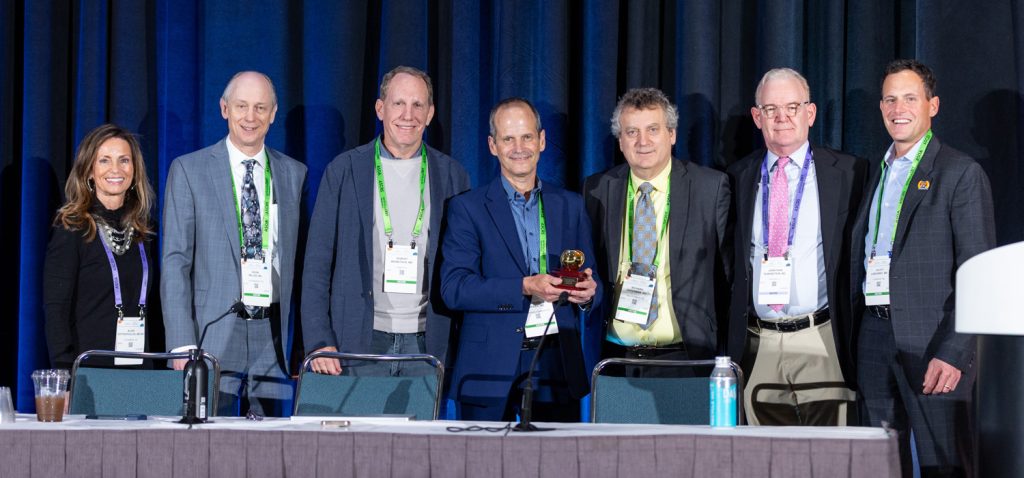
Source: ASCRS
In the discussion, after showing the case, Dr. Safran elaborated that he decided to perform the vitrectomy, recover and remove the dislocated lens from the retina, perform a secondary IOL procedure, and perform a new PK. He said open sky conditions would have greater risk in several areas, which could endanger the patient’s only eye. He also didn’t want the patient being aphakic for a long time and being unable to function. Dr. Safran noted that performing the PK and doing the secondary IOL procedure later could risk damaging endothelial cells as well.
With the patient under general anesthesia, Dr. Safran performed a vitrectomy and brought the old acrylic lens up into the anterior segment. From there, he cut the IOL in half with microscissors, taking out each half in turn. He said he had to burp out Soemmering’s ring material through the clear corneal incision using infusion.
Next, prior to performing Yamane intrascleral haptic fixation, Dr. Safran scraped the failed PK cornea to gain greater visibility. Since the beginning of the case, he had chandelier endoillumination for visibility as well.
After the lens was in place using the Yamane technique, Dr. Safran performed a peripheral iridotomy to prevent reverse pupillary block and began the PK part of the procedure, which was straightforward. In an interview postop, the patient said, “I see better now than when I came in.”
On postop day 1, the patient was 20/80 uncorrected and “extremely pleased,” according to Dr. Safran. By postop month 1, the patient was 20/40 uncorrected.
During discussion about the case, the panel and Dr. Safran talked a lot about surgeon comfort, with some on the panel noting that not all surgeons would be comfortable performing the retinal part of the procedure, or even a PK. Dr. Safran said that you have to do what you’re comfortable with, even if that means referring part or all of the procedure to another surgeon, and what’s best for the patient.
Dr. Safran said not many surgeons are being taught PK in residency anymore, for example. He said it’s a lost art. “It’s great that we have these lamellar procedures … but it’s sad that the baby is getting thrown out with the bath water because people are afraid of it,” he said, explaining that PK is a “great procedure in a patient who has stromal and endothelial disease.”
When it comes to the stress of performing surgery on a monocular patient, Dr. Safran said he doesn’t find these cases stressful anymore. He said you get used to confronting this stress. “Once you convince yourself that your best will come out, and you believe that, you’re much more likely to be able to do it. … It’s one of the hurdles that you have to overcome,” he said.
Relevant disclosures
Safran: None