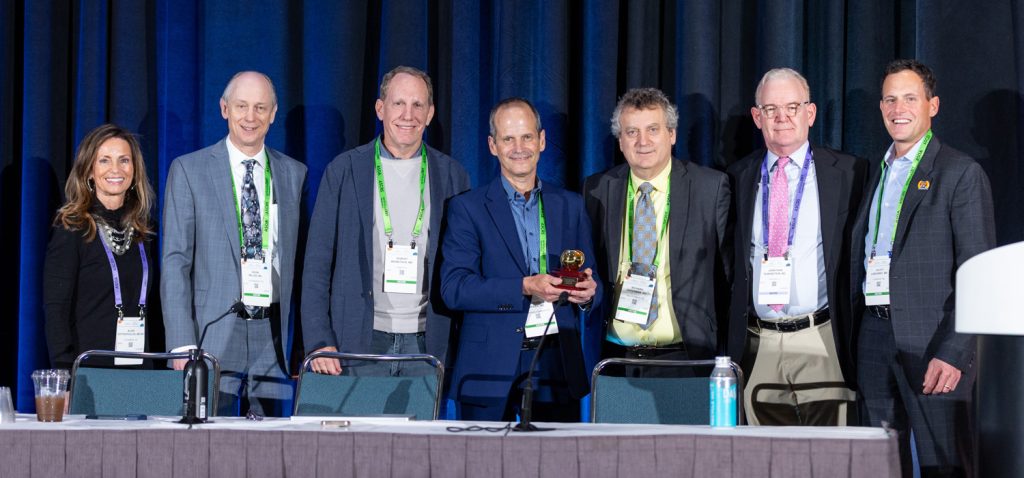
X-Rounds: Refractive Cataract Surgery to the Max, a non-CME symposium, is an annual highlight hosted by Eric Donnenfeld, MD, with the “superheroes” of ophthalmology, who gave quick hit presentations to answer various questions that were then voted on by the audience.

Source: ASCRS
Below are the winners from this year’s discussion categories.
What am I doing differently this year?
Preeya Gupta, MD, won this section for her presentation on using vision simulation prior to cataract surgery. She said she uses GreenMan Vision with InSightVR software.
The system consists of a virtual reality headset that’s worn by the patient to simulate postop acuity and visual function with different IOL technologies and refractive targets. The goal, Dr. Gupta said, is to educate patients and demystify IOL selection. It can also help guide adoption of advanced-technology IOLs (toric, presbyopia-correcting, etc.)
“We need patients to be able to touch, feel, and see to believe,” Dr. Gupta said, and she thinks this technology can help get them there. She mentioned a pilot study that showed use of the virtual reality headset compared to traditional education methods resulted in a higher adoption rate of advanced-technology lenses.
New technology on the horizon
Kerry Solomon, MD, was voted the winner in this category for his presentation on DSLT (direct selective laser trabeculoplasty, Alcon). He showed a video of some of his first patients being treated, indicating how they were comfortable, standing up, and simply resting their chin in the chinrest for the 2.5-second procedure.
Dr. Solomon said DSLT allows physicians to do laser glaucoma procedures in an effective and efficient manner without disrupting clinic flow.
My best pearl for astigmatism management
Nicole Fram, MD, took home the most votes for her pearl, which was the use of Anterion (Heidelberg Engineering). She said it has been especially helpful for the post-LASIK patient. She said instead of having just a few places where we measure, this technology has 65 radial OCT scans with 16,000 data points. It takes into consideration indices of refraction that other biometers and other measurements don’t, providing a true corneal power.
Dr. Fram said this is a new method to predict total corneal power in challenging patient populations.
What I am excited about in presbyopic IOLs
Dr. Fram also won this category. She said she was most excited for the Rayner Galaxy IOL, which is not yet available in the U.S.
The problem with presbyopia-correcting IOLs is dysphotopsia and contrast lost. The Galaxy IOL was developed using AI trained on patient outcomes. It’s a spiral lens design that is refractive, non-diffractive with 0% loss of light. She said it offers a full range of vision, but it remains to be seen if it will minimize dysphotopsias.