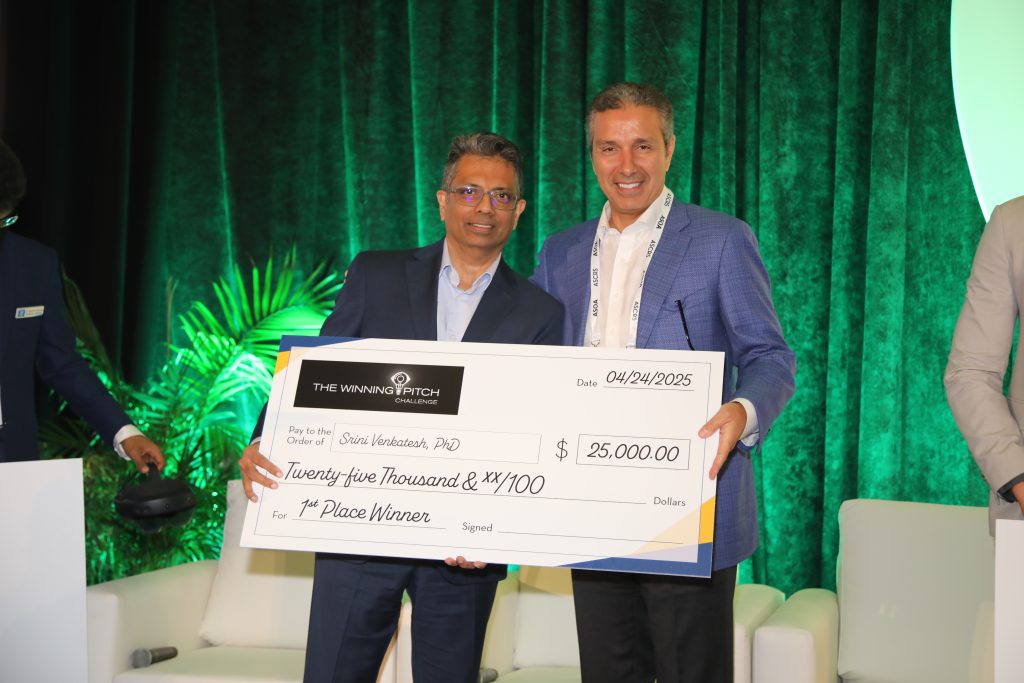
The ASCRS Foundation Board proudly announced its selection of Elena Barraquer, MD, for the 2025 Chang-Crandall Humanitarian Award. Endowed by a generous gift from David and Victoria Chang, the ASCRS Foundation Chang-Crandall Humanitarian Award was established in 2017 to honor and recognize outstanding humanitarian work in the field of cataract blindness and disability. The $100,000 award is donated to the awardee’s non-profit organization of choice. Dr. Barraquer has earmarked the financial prize for the Elena Barraquer Foundation.
For many years, Dr. Barraquer has led the Elena Barraquer Foundation, a nonprofit organization that fights avoidable blindness due to cataracts in developing countries. The foundation leads short-term surgical missions around the world to perform sight-restoring cataract surgery, taking all surgical equipment and supplies needed to perform the surgery. Over the last 6 years, the Elena Barraquer Foundation has provided access to eye health to more than 120,000 people in more than 20 countries. Additionally, the Elena Barraquer Foundation has performed 25,000 pro bono cataract surgeries, more than 50,000 medical consultations, and delivered more than 65,000 glasses.
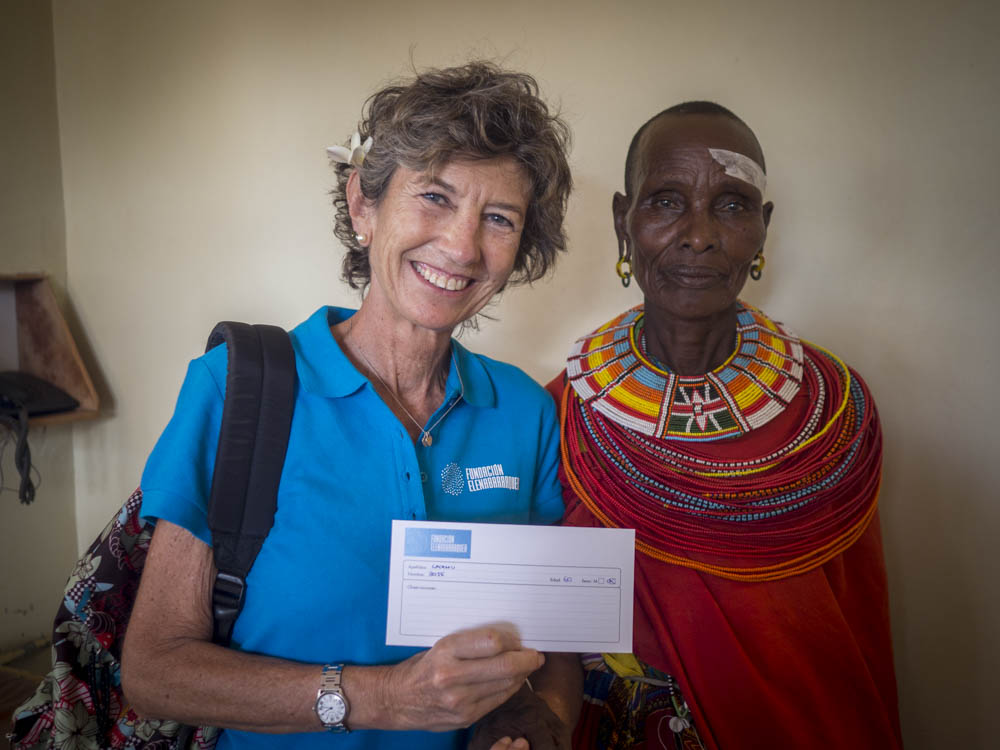
Source: Elena Barraquer Foundation
Dr. Barraquer’s interest in ophthalmology and humanitarian eyecare started from an early age, as she has a rich family history with ophthalmology and the Barraquer Ophthalmology Centre. Her grandparents lived in the building where the clinic was and her parents did as well. “My brother, my sister, and I lived inside an eye clinic,” she said. “I was seeing every day how my father and my grandfather enjoyed the work, enjoyed the profession, taking care of people.”
Not only did ophthalmology run in her family but so did a history of charitable work. “My grandfather also had a charity section because when he built the clinic, he was working at a private clinic that he owned and also at a public hospital. He didn’t want any of his patients to be left out. He decided that one side of the clinic was going to be for paying patients and another side for non-paying patients.” After her grandfather’s death, the clinic continued to offer charitable surgery and prices for those who couldn’t afford ophthalmic care.
Dr. Barraquer said her first job was in the U.S. at the National Eye Institute doing research. It was through this job that she ended up on her first ophthalmic mission trip in 1979. “When I was there, a team from the clinical part of the National Eye Institute was going to do a mission in Port-au-Prince, the capital of Haiti, and they asked me,” she said. “It was amazing, and I think that was the seed of what I’m doing now—my grandfather’s work and that trip that we took to Port-au-Prince.”
She saw many situations that didn’t need to exist and patients in need, which she noted often happens in countries where they don’t have the technological resources, the human resources, and monetary resources to afford healthcare that patients need.
Following her work at the National Eye Institute, she worked at Wilmer Eye Institute for 2 years doing eye pathology. She completed her residency at Mass Eye and Ear, followed by a cornea fellowship at Bascom Palmer Eye Institute. “After that, I married an Italian ophthalmologist, and I was in Italy for 13 years,” she said. “I had seen how ophthalmology is done in what are considered [some of] the best hospitals in the U.S.” With that and moving on to practice in Italy, Dr. Barraquer said this helped when she came back to Barcelona in 2002. She was able to bring interesting insights from training and learning in other countries that could help show different ways to do things.
Dr. Barraquer was previously involved with humanitarian work with the Barraquer Foundation, which was started in 2003 by her father.
In 2004, Dr. Barraquer did her first trip to Africa through the Barraquer Foundation, traveling to Senegal, where she saw the great need. For 13 years, Dr. Barraquer was the executive director of the Barraquer Foundation. When her father died at the end of 2016, she took over the patronage of the Barraquer Foundation. It was also decided at that time that the foundation would focus more on work in Spain and the backlog of procedures in the country.
“I knew that our needs in Africa are a thousand times more,” Dr. Barraquer said. For example, in countries like Mozambique, there are 20 million people and only 20 ophthalmologists, so there’s no way to address this problem. “Not only don’t they have the technology or the economic resources, but they don’t have the human resources,” she said. “I decided then to start [a new foundation]—the Elena Barraquer Foundation—to exclusively do trips to developing or underdeveloped countries to help wherever they need us.”
The first trip for the Elena Barraquer Foundation was to Kenya in 2017. “We went to Kenya, hand in hand with another NGO from Barcelona with whom we had traveled to Kenya six times before with the Barraquer Foundation,” she said.
When the Elena Barraquer Foundation started in 2017, Dr. Barraquer said it comprised of only herself, Teté Ferreiro, executive director, and a scrub nurse. This expanded, and there are now 10 people in Barcelona who work every day preparing the campaigns and outreach. Dr. Barraquer continues to work with the Elena Barraquer Foundation and with the Barraquer Institute. Last year, the Elena Barraquer Foundation completed 18 humanitarian trips, with cataract surgery as the main focus.
During her trips, Dr. Barraquer said there have been many memorable experiences. One was a trip to Kenya in the Samburu region in the north of the country. The Samburus are a nomad tribe, so they move around, and they walk everywhere. She treated a 33-year-old Samburu man. “He came with a typical warrior dress, and he was very drunk. He was blind in both eyes. He had such an incredible cataract that he only saw light perception with both eyes,” she said. “I did one eye. One of them was actually subluxated, so I had to do an intracapsular.” The following day, he came to have the patch removed, and Dr. Barraquer did surgery on the other eye. When he returned the day after to have the second eye patch off, he could see with the first eye that was operated on. “He said to me, ‘Thank you. Now I’m going to be able to find a job.’ It was incredible.”
Another particularly memorable experience of Dr. Barraquer’s was an 18-year-old woman who had lost one eye because of a retinal detachment and had a white cataract in the other eye. “That was in Angola, and they speak Portuguese, which is similar to Spanish. I did the surgery on the eye with a white cataract, with local anesthesia, and at the end, I said, ‘We are done. Can you see my hand?’ She said, ‘Yes, I can see your hand.’ I said, ‘How many fingers are here?’ Before she answered her face went into a huge smile, and she said, ‘Two.’ She had an 18-month-old baby, and she said, ‘Now I’m going to be able to see his face.’”
It’s these memories and cases that keep you coming back, Dr. Barraquer said.
“Please join me in honoring Dr. Barraquer, a woman who is a brilliant surgeon, a remarkable humanitarian, and a spectacular role model,” said Susan MacDonald, MD, ASCRS Foundation Chair. “[With] her unwavering focus on delivering quality eyecare to underserved communities through her compassion and expertise, she inspires all of us to join the mission of reducing needless blindness.”
“It is a privilege to recognize Elena Barraquer, MD, as this year’s recipient of the Chang-Crandall Humanitarian Award,” said Lisa Park, MD, chair of the award’s Nominating Committee. “The Committee was impressed with the years she dedicated to training and research in the U.S. and humanitarian efforts around the world from an early age. I would like to highlight that Elena was one of the few women in this illustrious group for this award and received the top number of votes from the Committee by a large margin. It is my great pleasure to acknowledge and recognize this physician whose work has gone beyond the call of duty and embodies the true spirit of this award.”