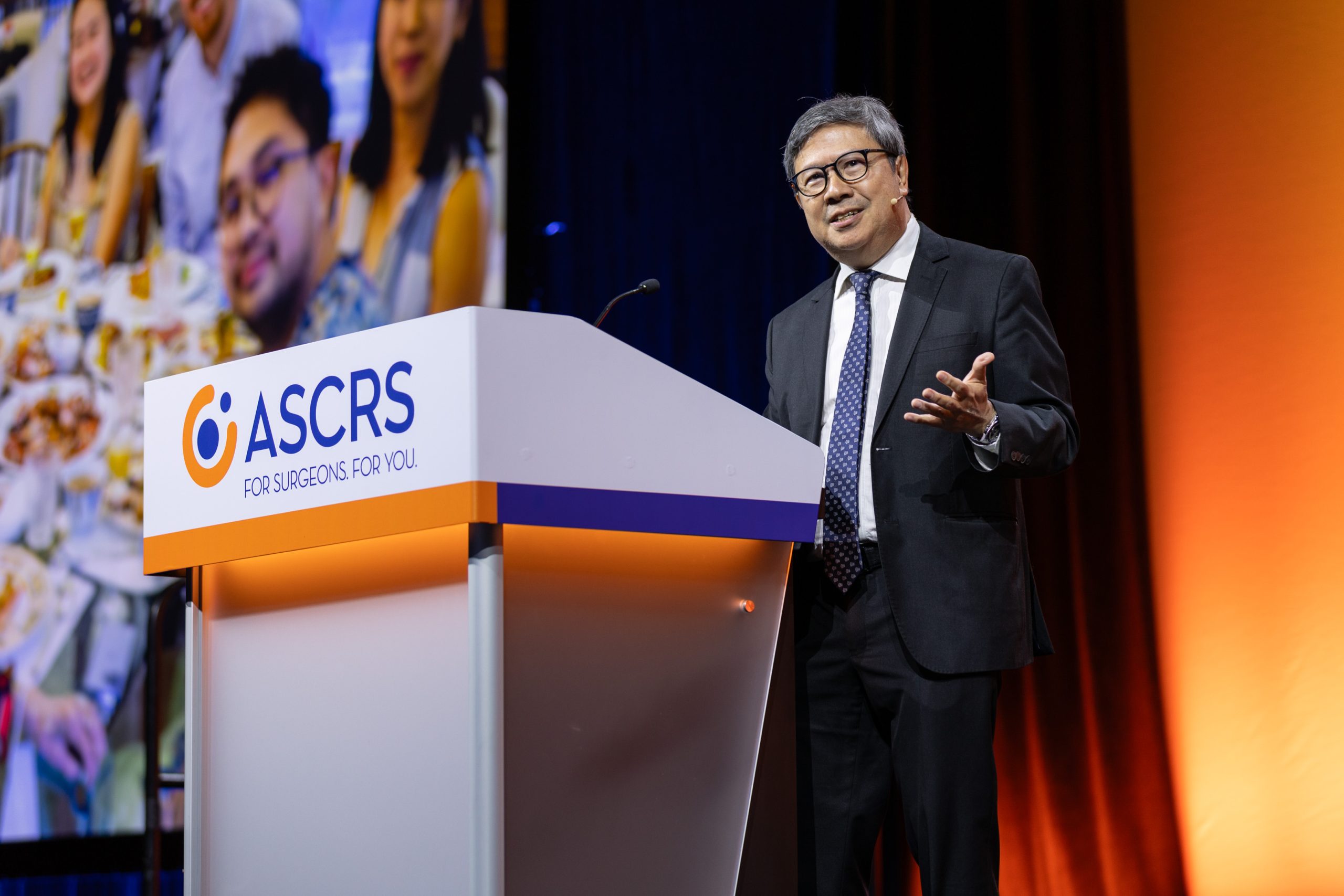
This year’s Cornelius D. Binkhorst, MD, Lecture was given by Ronald Yeoh, MD.
“Ron has left an indelible signature on ophthalmology,” said Thomas Samuelson, MD. He has concentrated his teaching and clinical work on cataract surgery, Dr. Samuelson said, adding that he has led many courses.
Source: ASCRS
Dr. Yeoh’s lecture was titled “Hydro Chronicles,” and he said it would detail his 30-year love affair with hydrodissection. It’s not glamorous, but we all do this almost daily in cataract surgery, he said. Hydrodissection only takes around 10 seconds, but the time it takes is disproportionate to its importance.
He detailed some of his experiences, including experimenting with using a side port incision. He suggested not doing hydrodissection through the side port because it’s a closed chamber, and higher pressures are generated.
He discussed hydrorupture and the pupil snap sign, when the pupil abruptly constricts with a snap at the moment the fluid bolus bursts through the posterior capsule and the nucleus sags backward.
What is the significance of the pupil snap sign? Dr. Yeoh said it helps to avoid a dropped nucleus. However, the nucleus usually drops slowly.
Dr. Yeoh described three cardinal signs of adequate hydrodissection:
- Fluid wave
- Nucleus lift
- Nucleus prolapse
There’s no real need to rotate the nucleus, he said.
Discussing nucleus lift, Dr. Yeoh said is not always obvious. Three subsidiary signs of nuclear lift are:
- CCC/pupil enlargement
- Overlying cortex splitting
- Push-back sign with a “pop”
The introduction of intraoperative OCT also played a role in hydrodissection; before this, there was only a microscope view of hydrodissection.
Dr. Yeoh also discussed other hydrodissection techniques and nuances he has learned over the years.
Financial disclosures
Yeoh: None