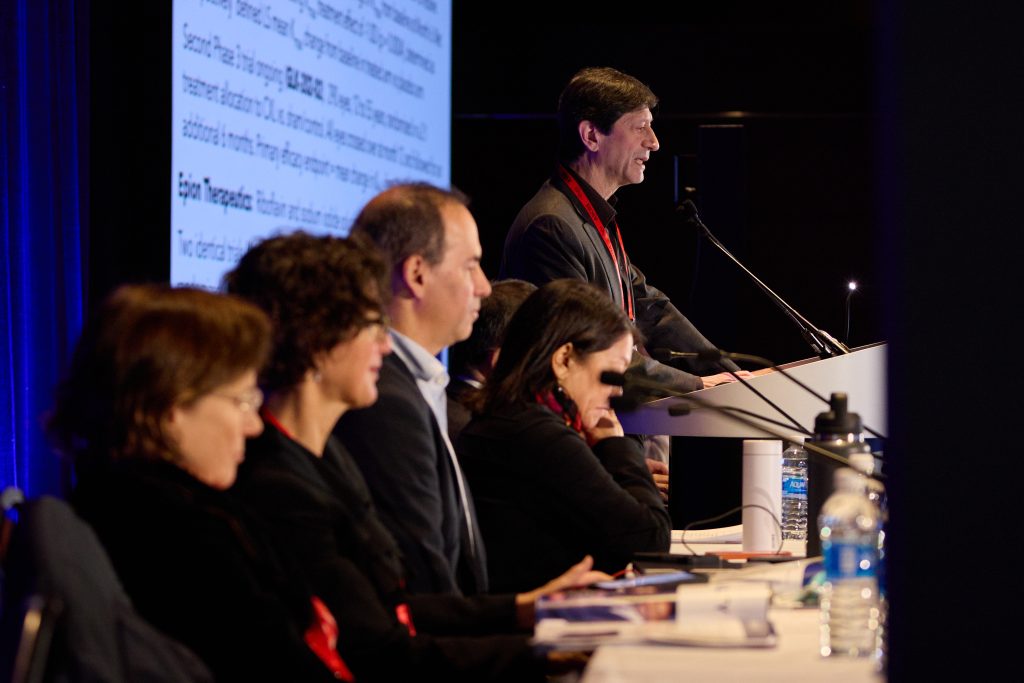
“We are on the eve of a fundamental understanding of trabecular meshwork that will allow us to both describe the pathophysiology of glaucoma and intervene at the molecular level,” said Douglas Rhee, MD, when giving the Stephen A. Obstbaum, MD, Honored Lecture.
Dr. Rhee took ASCRS Glaucoma Day attendees on his “Quest to Lower IOP: Medical, Laser, Surgical, and Molecular Approaches.” He said the intent of his talk was to help attendees understand and be more armed to have discussions with patients about what causes glaucoma.

Source: ASCRS
Dr. Rhee started his presentation reminding the audience that elevated IOP has nothing to do with aqueous hypersecretion. It’s a problem with the drainage of the eye. “We’ve known this for a very long time,” he said. “The trabecular meshwork is the anatomic site of resistance.” More specifically, Dr. Rhee said it’s the juxtacanalicular region, which he noted is constantly undergoing cellular remodeling.
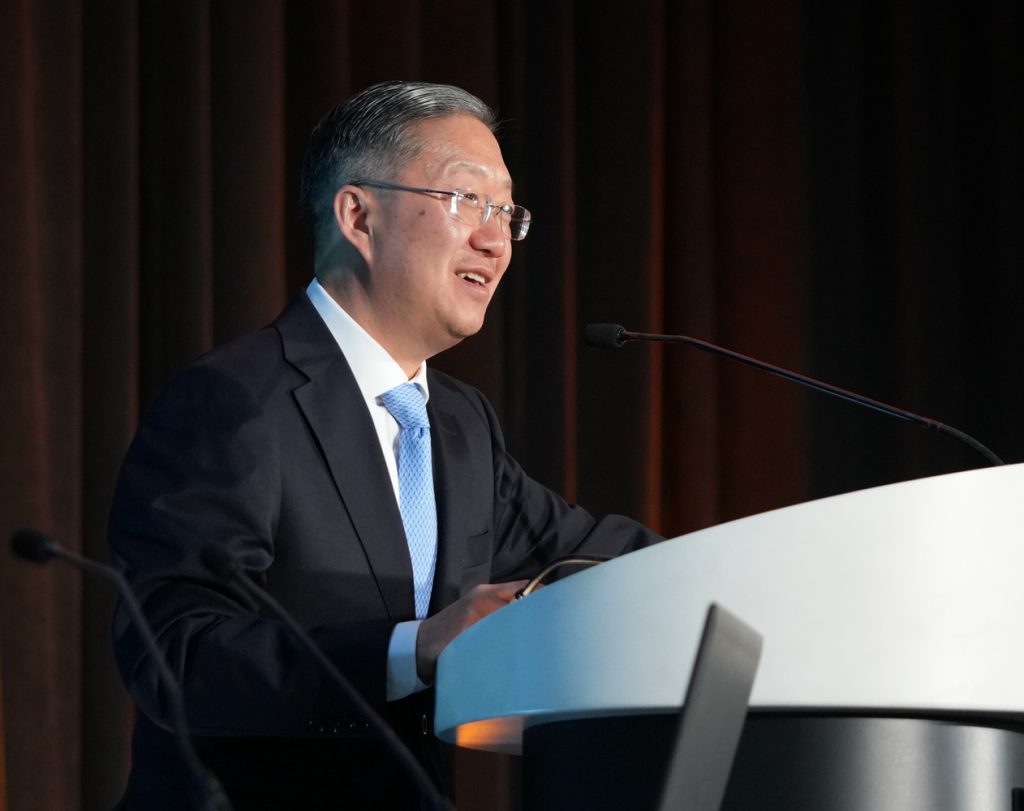
When it comes to the pathophysiology of elevated IOP, Dr. Rhee said that research has shown that TGFβ2 is elevated up to 3x more in glaucoma patients. When TGFβ2 is given in an experimental model system, it replicates glaucoma.
Source: ASCRS
From here, Dr. Rhee discussed the different therapeutic approaches to glaucoma and what’s been discovered based on these approaches. One of these was how prostaglandin analogs were found to induce the ciliary body smooth muscle cells to secrete more matrix metalloproteinases (MMPs), which degraded extracellular matrix and enhanced uveoscleral outflow. His lab found that trabecular meshwork and the ciliary body expressed the same MMPs and TIMPs and elucidated on the importance of MMP:TIMP balance for outflow. PGAs were found to affect that balance in a dose-dependent manner (higher concentrations had a greater effect).
He said that lymphangiogenesis may be why we’re getting a sustained IOP reduction. In mice, bimatoprost-free acid increased the presence of certain markers of proteins and at the gene transcript level.
At one point in his presentation, Dr. Rhee said that “everything we’re doing now … is palliative.” He added later that to stop and interrupt the disease pathology we need to understand it. We know that the extracellular matrix in the trabecular meshwork is important in controlling IOP. And we believe that the proteins that control extracellular matrix in other tissues with have an effect on the trabecular meshwork.
Research has been done to identify matricellular proteins. Dr. Rhee said they conducted single gene knockout studies in mice with the proteins they identified and found that three had an effect on lowering IOP. They focused further research on SPARC, which had the greatest IOP lowering effect when knocked out. More research found that TGFβ2 increases with SPARC and, Dr. Rhee reminded, if you give TGFβ2, it increases IOP.
In wild-type mice, who did not make SPARC, if you give them TGFβ2, you cannot induce glaucoma. “Mice that can’t make SPARC can’t get glaucoma,” Dr. Rhee said.
“So what we’re doing next is elucidating those mechanisms. Those publications are forthcoming,” Dr. Rhee said, adding that the protein SPARC has risen to the level of evidence and is believed to be a key protein that regulates IOP.
Financial disclosures
Rhee: AbbVie, Alcon, Iantrek, iStar, Qlaris