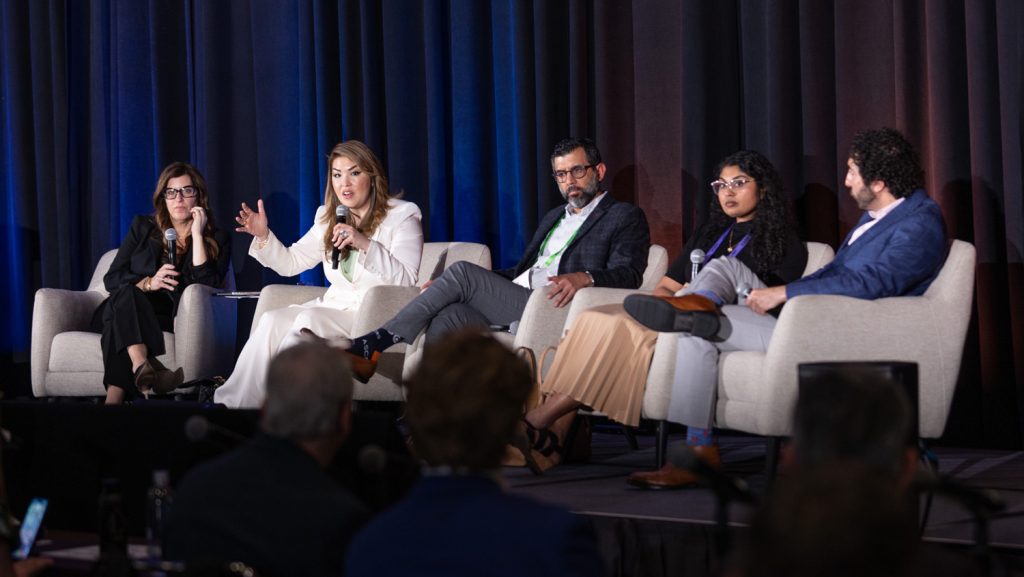

“Medicare’s inability to pay for everything should not inhibit innovation,” Matt Jensen said, quoting former congressman Chris Cox, who was on a SightLine at ASCRS panel in a prior session about building the premium IOL payment category, using this quote as a segue into a session he moderated on the topic of paying for enhanced diagnostic technologies.
Mr. Jensen, a “recovering administrator” (his words), said payors don’t decide the value for a patient, rather whether they’re going to cover it from a budgetary standpoint.

Source: ASCRS
Mr. Jensen asked Dagny Zhu, MD, Nicole Fram, MD, and administrator Melissa Ciccarelli, COE, to talk about how their practices have implemented alternative payment models.
Dr. Zhu said she represents the “extreme” of patient-pay models with her practice being an entirely self-pay, cash-pay practice that has opted out of taking insurance. “We focus on delivering the best service and experience to our patients. … I can give them the best outcome without having to think of being reimbursed,” Dr. Zhu said. “We make patients see the value of every technology we’re using to screen them for cataract surgery or dry eye. Patients are willing to pay out of pocket because they see that value.”
Dr. Fram said that her practice does accept insurance but also tries to use the most innovative technology. “There’s not a machine that I don’t love, so I had to figure out a way to pay for that,” she said. Dr. Fram’s practice has adopted a model where patients can have standard surgery that’s insurance covered or they can opt for a refractive package that has elements they will pay for out of pocket but will take them to the next level in terms of visual outcomes and incorporates more hands-on care through the process, including postop. Dr. Fram also said they have an administrative fee that’s charged to patients for the concierge-type services patients expect, which covers the cost of the administrative employee who answers calls, helps with prior authorizations, etc.
Ms. Ciccarelli, who works in the practice of Steven Dell, MD, said they have an advanced diagnostic testing services model. These, she explained, are built based on the appointment the patient is coming in for—cataract, refractive, or dry eye. “This revenue stream gives us the freedom to explore these new technologies and bring them into our practice,” she said.
Dr. Zhu said that while her practice is entirely cash pay, it’s important to point out that some of the screening technologies that are performed to make sure the eye is healthy for otherwise non-covered services can be reimbursed. “There are ways to get around it where you can get paid for some of these screening diagnostics,” she said. Even if you need to charge patients out of pocket for a test, device, or pharmaceutical, it doesn’t have to be a huge fee, she explained later. “The value, that revenue, adds up over time,” Dr. Zhu said. Dr. Fram chimed in, “Thirty dollars over 3,500 visits can add up to something significant.”
Ms. Ciccarelli spoke about how, in patient-pay models for advanced diagnostic technologies that ophthalmologists want and rely on, it’s important that all staff members within the practice be informed and on board. She said front desk staff are your ambassadors, and they need to understand the value of the advanced testing. “Patients will ask random people in your office questions. It’s vital that every person in your staff understands that value,” Ms. Ciccarelli said, adding that patients will have no problem paying additional fees when they truly understand the value, as explained to them consistently by the surgeon and practice staff members.