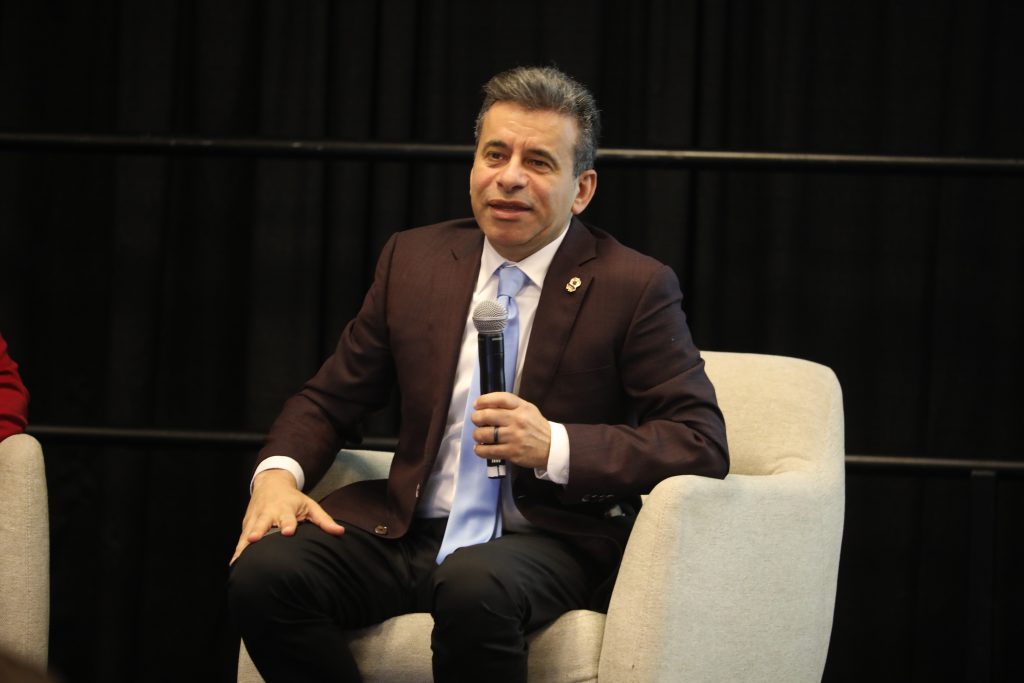
This year’s invited speaker in the Government Relations symposium was Ron Brownstein. Mr. Brownstein is a Senior Political Analyst for CNN, Bloomberg Opinion Columnist, and former Senior Editor for The Atlantic.
The level of engagement of the public in our politics is at an all-time peak, he said. “Americans are invested in the choices we face.” However, Americans are also deeply polarized in the choices we face. Washington is embroiled in policy debates but also on fundamental questions that we don’t have a lot of muscle memory on debating. At the state level, red and blue states are hurtling in opposite directions on issues.

Source: ASCRS
As a country we’re closely divided but also deeply divided, Mr. Brownstein said. You have a volatile compound. The stakes are higher and more unrelenting, and this shapes the ways politics evolve on a lot of issues.
Voters are treating elections more like parliamentary contests, he said. The key issue isn’t merits; it’s which party you want to see in control of Congress. “We’ve reached a point where the color on the front of the jersey in the elections matters more than the name on the back of the jersey.”
Mr. Brownstein noted that the party’s broad image matters in a presidential election, so if Democrats can’t improve their image, it’s going to be an issue in 2028. In off-year elections, it matters who is in the White House, he said, referencing the election in November 2025, where even with unfavorable views of the Democratic Party, voters elected Democratic candidates for governor in Virginia and New Jersey. This frames the challenges for Republicans this year.
Mr. Brownstein also noted that President Trump’s approval on the economy is almost always lower than his overall approval rating. That’s significant, he said. In his first term, it was almost always higher. Most voters in polls are saying that they do not see him making progress on the biggest problem they elected him to solve, which was getting cost of living under control. Many went from thinking he was ignoring the problem of inflation to thinking he’s compounding the problem of inflation. Now, the war in Iran has added to that. Going into the war, they didn’t think he was doing enough. Now, the war is both a distraction from that and an accelerant with the high gas prices. High gas prices remaining elevated for any period of time is a danger to Republicans running in 2026, he said.
Addressing further why it’s currently like a “parliamentary contest,” Mr. Brownstein said we’re living through generational, demographic, geographic sorting out where parties are representing different Americans. The general trend of politics remains that Democrats are stronger in big metros everywhere (in any state). When you look outside of that, Republicans are consolidating their hold.
If you look at the state level, it’s very much the same story, he said. Our fundamental reality is we are closely divided and deeply divided. Because we are deeply divided, each time there’s a change in power between parties, the new party wants to erase the blackboard of the previous administration. Because we are closely divided, we get those changes more often than we did in the past. “This gives us whiplash,” he said. It’s also a difficult formula to run a country, and it’s not easy for any institution to plan.
He noted how this whiplash is particularly profound in healthcare. There are many places we’re seeing cuts, and not because of complaints about quality of work but because their institutions don’t accept President Trump’s demands on unrelated issues.
If we pull back from which party will hold the upper hand, the overall picture of what this dynamic means for the country is pretty sobering, Mr. Brownstein said. “I don’t think leadership to bring us out of this heightened level of conflict will come from within the political system,” he said. Leadership to bring us out of this current impasse is going to have to come from the outside in, from constituents often at odds finding ways to reach agreements on the biggest issues.
What’s becoming urgent is for Americans to build alliances across ideological party lines, Mr. Brownstein said.