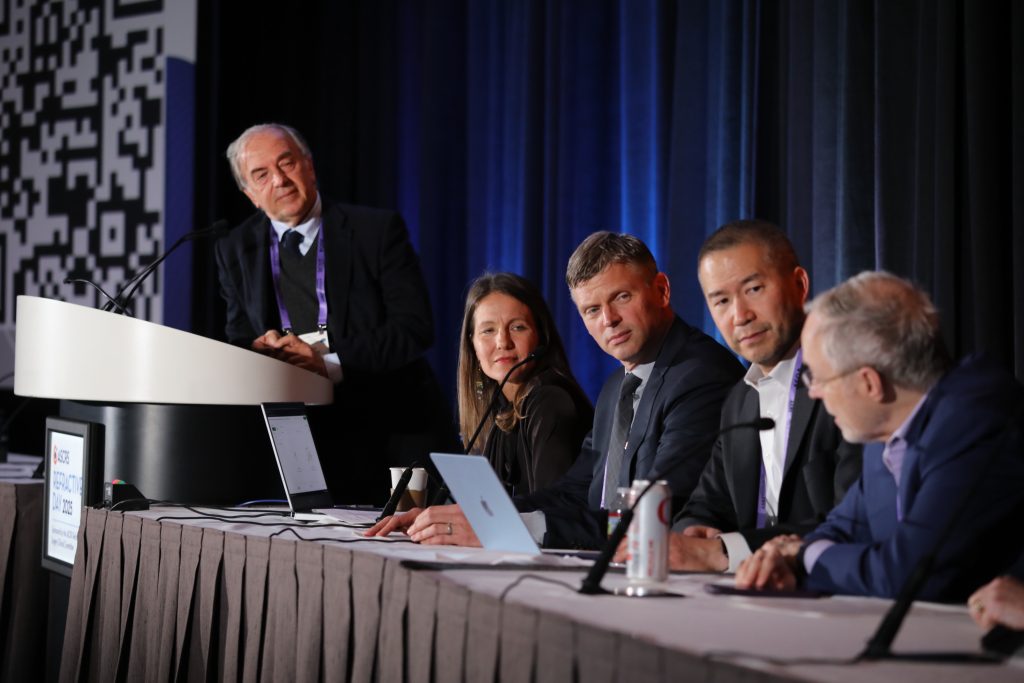
ASCRS Has Got Talent, a Saturday afternoon session on the Main Stage moderated by David F. Chang, MD, featured four international teams of cataract surgeons representing North America, Latin America, Europe, and Asia-Pacific. Each team highlighted practical pearls for routine and complicated cataract surgery and advanced-technology IOLs.
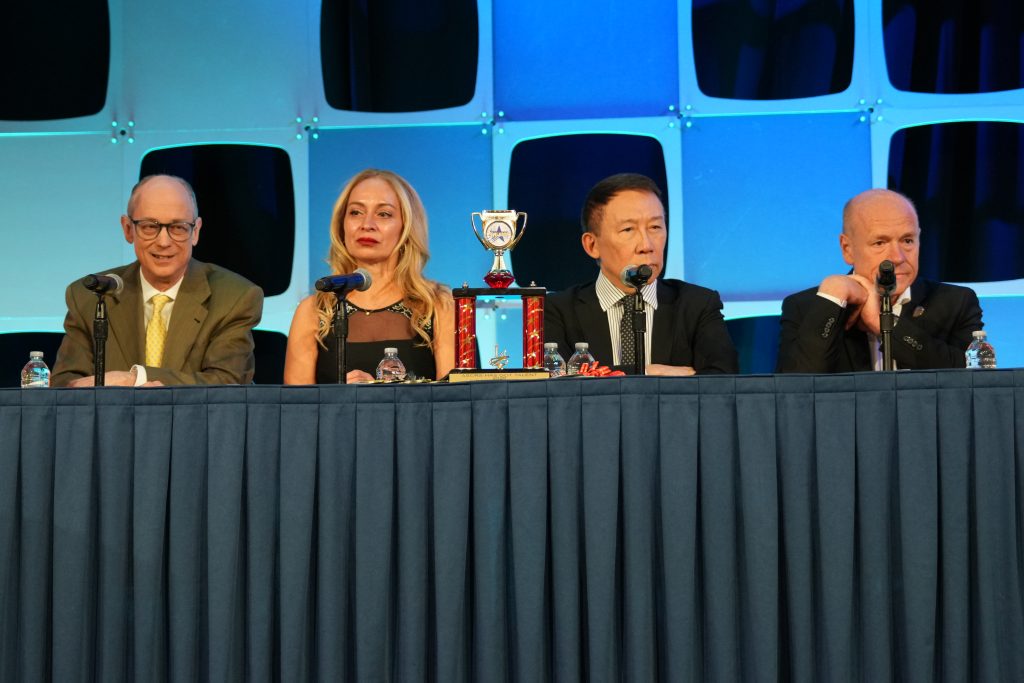
These teams were critiqued by the international panel of judges—Kevin Miller, MD, H. Burkhard Dick, MD, PhD, John Chang, MD, and Josefina Botta, MD—and the best talk in each category was voted upon by the audience.
The competition began with the category of Cataract Surgical Tips. Here’s what each team presented on within that category:
Team North America
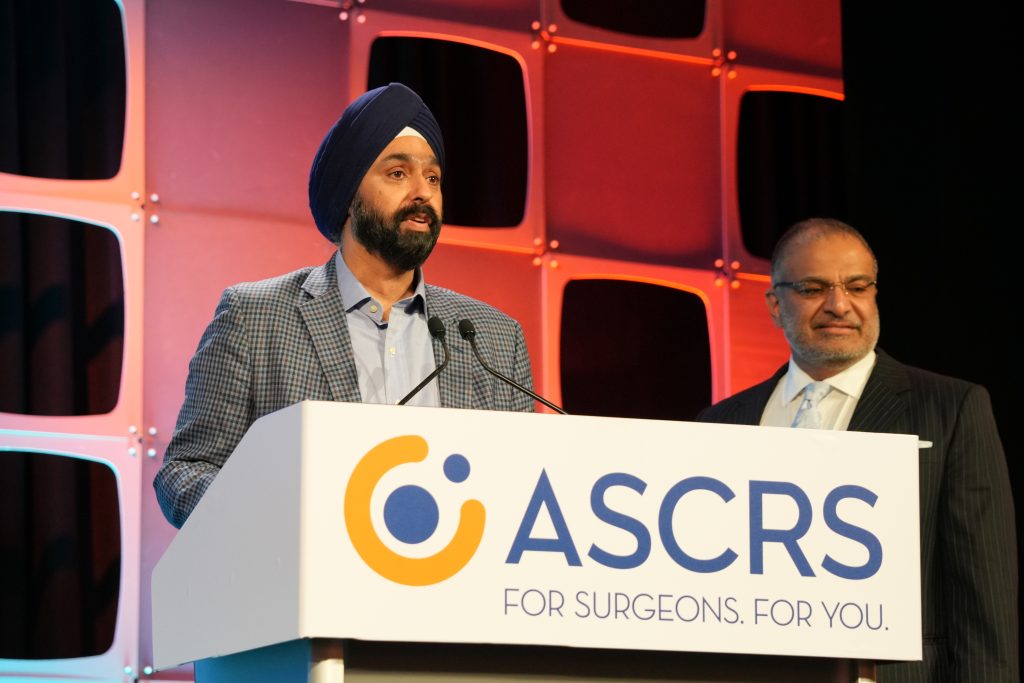
Inder P. Singh, MD, shared his technique for a one-step needle vitrector that could be used for floaters or before you do a lens exchange or Light Adjustable Lens (LAL, RxSight). He said you put in an AC maintainer 3.5 mm behind the limbus and with a 27-gauge needle, go straight into the anterior part of the vitreous. Maintain low vacuum (under 100) and just hold it there, he said. The whole idea is to remove vitreous that’s liquid. You’re not trying to pull any vitreous from the base or retina. Dr. Singh said B-scan evidence shows no pulling or traction.
Uday Devgan, MD, showcased his twist and out IOL explant technique that doesn’t require any special instruments. It requires tying forceps in one hand and a spatula in the other. With one haptic out of the incision and the AC full of viscoelastic, you grab the optic at one edge with the forceps, insert the spatula through a paracentesis above the optic, rolling the optic as your hand rotates from a supinated to pronated position. This works on hydrophobic and hydrophilic lenses, Dr. Devgan said.
Source: ASCRS
Source: ASCRS
Team Asia-Pacific
Pannet Pangputhipong, MD, PhD, described an I/A capsulotomy technique to avoid the Argentinian flag sign in a white cataract. This technique makes a flat surface under low pressure, reducing risk for capsulotomy runout. His key message is to avoid creating the initial capsulotomy under viscoelastic because it doesn’t allow depressurization.
Robert Edward Ang, MD, shared tips for safe removal of adherent cortex. First, he said to go under the IOL to remove as much adherent cortex as possible using a coaxial I/A probe to polish. For larger areas of adherent cortical material, the edge of the IOL could be used to massage the posterior capsule and dislodge the cortex for easier removal.
Team Europe/Middle East
Ruth Lapid-Gortzak, MD, PhD, spoke about hydrodelineation, conducting phaco under the protection of the cortex shell. “You want to get this golden line within,” she said. Her teammate Ahmed Ghoneim, MD, reminded attendees to watch for zonular instability. “Keep eyes on the zonules all the time, all day, and [during] all the steps,” he said. During his presentation he showed several examples of the pupil snap sign, subtle movement of the pupil that indicates zonular issues.
Team Latin America
Lyle Newball, MD, provided another technique for depressurizing white cataracts. First, he said to perform UBM with these cataracts to get more information. He discussed posterior chamber decompression and the necessity for slow withdrawal of the needle when coming out of the eye. He performed the capsulorhexis with microforceps. During the case, Dr. Newball said it’s important to maintain the chamber with viscoelastic or air, especially during instrument exchange. He always requests a three-piece IOL for use just in case the capsulorhexis does end up running out.
Teammate Laura Cunha, MD, gave her practical tips on being READY. “Efficiency is not about speed. It’s about fewer interruptions, fewer surprises, and better flow,” she said. The letter R represents the right eye and the right IOL (check your biometry and patient information). The E is for making sure your equipment is ready (check phaco, settings, fluidics, and instruments). The A represents aligning the patient; a well-centered patient saves time, improves ergonomics, and makes every step smoother. The D is for “do the time out.” This prevents mistakes and aligns the OR team. Finally, the Y is for “your flow,” take a deep breath and control your anxiety. “Don’t start fast. … Start ready,” Dr. Cunha said.
The winner of this category was Team North America. Other presentation categories included refractive IOL tips and complications/complex cases. New pairs from each team competed within each of these categories. The overall winner of ASCRS Has Got Talent was Team North America.