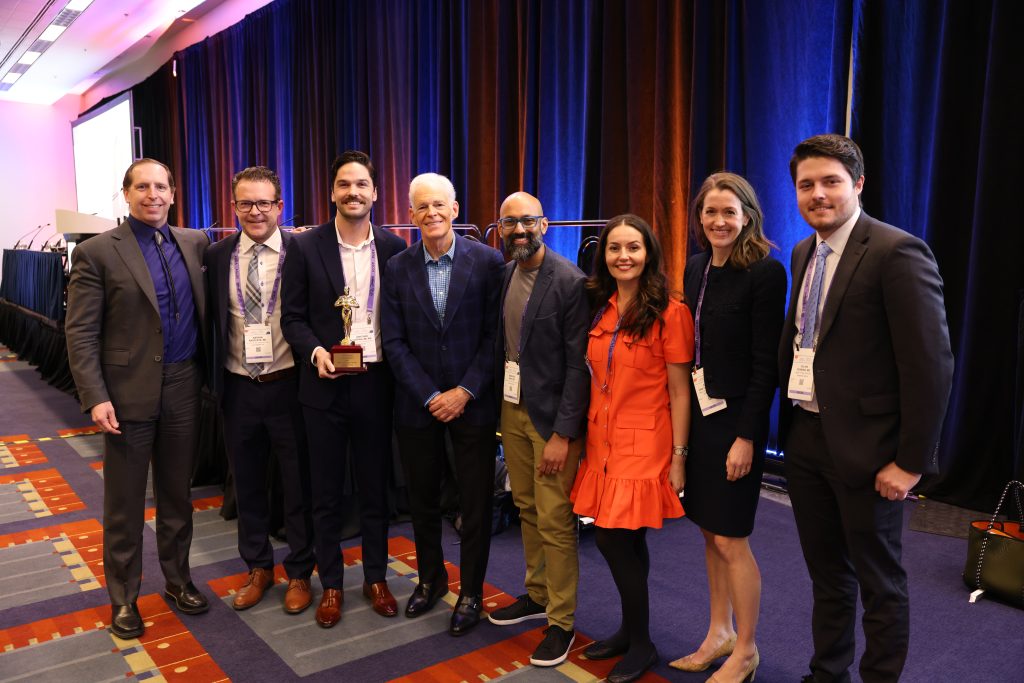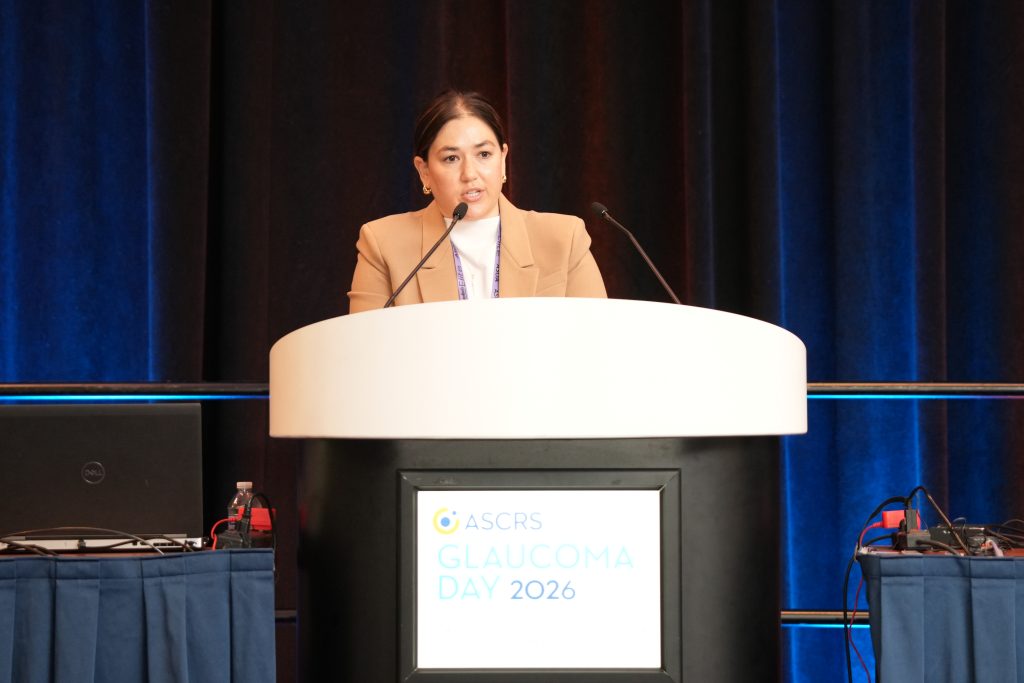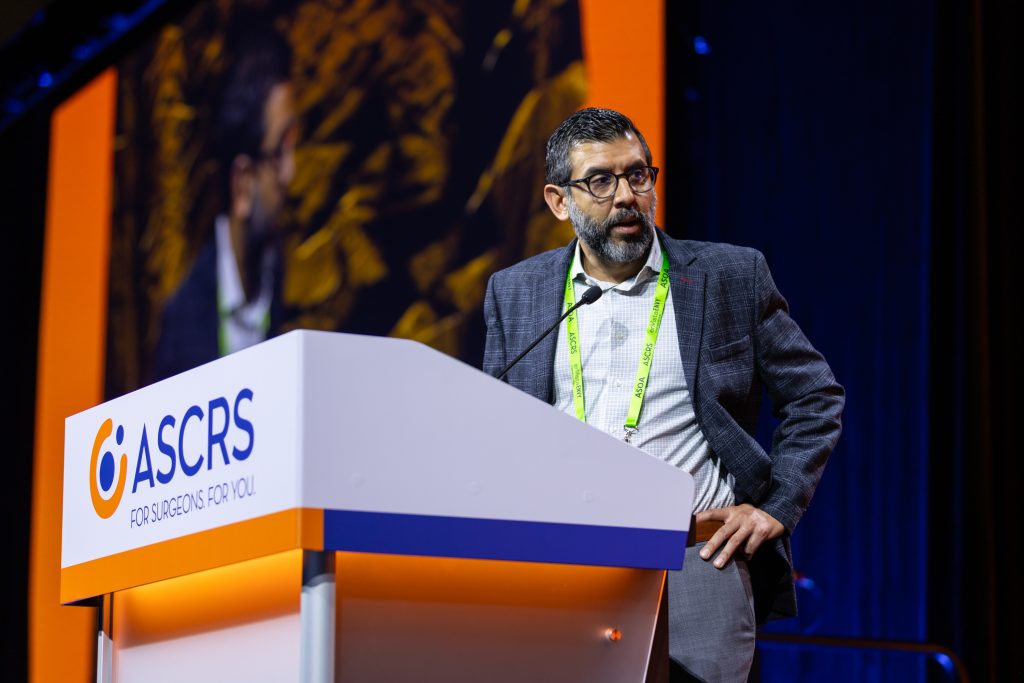
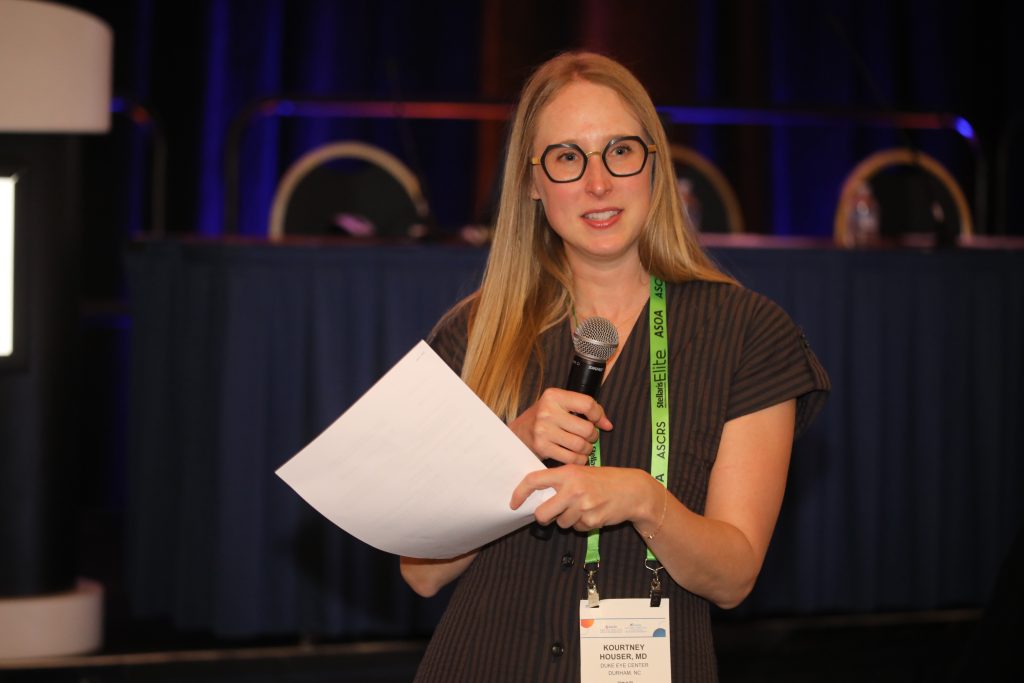
Zaina Al-Mohtaseb, MD, and Kourtney Houser, MD, moderated the YES symposium on Saturday afternoon, titled “Surgical Resilience – Bouncing Back from the Unexpected Video Symposium.” The session was an interactive video symposium where presenters, including current residents, showed difficult cases and complications in the OR. A panel of surgeons provided guidance for the cases and shared how they would work through similar cases.
Sabrina Mukhtar, MD, presented a case titled “Returning From a Rent.” She operated on a patient’s left eye, which had a very dense brunescent white cataract.
She utilized iris hooks to help with visualization. The patient had some posterior synechiae, Dr. Mukhtar said, adding that she tends to paint trypan underneath dispersive viscoelastic, especially if she’s not clear on what the zonular integrity would look like. “The main thing I was looking at was the area of posterior synechiae,” she said, adding that she was nervous the rhexis would run out. There was an early rent, and Dr. Mukhtar tried to use maneuvers to bring the rhexis down perpendicularly. Visualization wasn’t great, and she used intraocular scissors to cut the rest of the remaining intact capsule so she could start the phaco portion of the cataract surgery. She was able to easily do that and remove the anterior capsule from that point. She then proceeded with nuclear disassembly but was careful not to put stress on the capsule.
The patient had anterior capsule rent, but it didn’t look like it wrapped to the posterior. Dr. Mukhtar added that she will inject cohesive viscoelastic even in routine cases to keep herself well prepared. But she also wanted to avoid filling the bag because she didn’t want the rent to run out further.
Dr. Mukhtar decided to proceed with a one-piece IOL because she thought the support would be best. She decided against a three-piece in the sulcus because she felt the patient might have difficulty with compliance after surgery. She then removed the iris hooks and used acetylcholine chloride to make sure the pupil would constrict. The patient was 20/30 at postop week 1.
Source: ASCRS
Filling the anterior chamber before coming out is so important, Dr. Houser said during the panel discussion of the case.
She also brought up considering a three-piece lens. A three-piece is nice, Dr. Houser said, because if the haptic rotated, it wouldn’t cause UGH syndrome. However, she said you could use a one-piece or three-piece lens.
Ashraf Ahmad, MD, noted that using the femtosecond laser may be helpful with white cataracts. He also said with anterior chamber rent to pay attention to the leaflets. If they’re flapping back and forth, there’s not a lot of stress, so it’s less likely for them to radialize.
Ryan Smith, MD, said that the femtosecond laser is nice for white cataracts, but he cautioned that it can be a problem when there’s a fibrotic area. He said he still stains his white cataracts.
Dr. Al-Mohtaseb noted that she would use the IOLMaster (Zeiss) on preop exam, and she also suggested looking at the space between the iris and lens inferiorly. Dr. Houser said she likes to look at the clefts on exam as well.
Editors’ note: Dr. Al-Mohtaseb has financial disclosures with Alcon, AbbVie, Bausch + Lomb, and BVI. Dr. Houser has financial disclosures with Alcon, Bausch + Lomb, and Zeiss. Dr. Mukhtar has financial disclosures with STAAR Surgical. Dr. Ahmad and Dr. Smith have no relevant financial disclosures.