The ASCRS/AGS Joint Symposium at ASCRS Glaucoma Day, Friday, April 10, looked at everything from AI’s impact on glaucoma to MIBS to how innovations in cataract surgery are benefitting glaucoma patients and more.
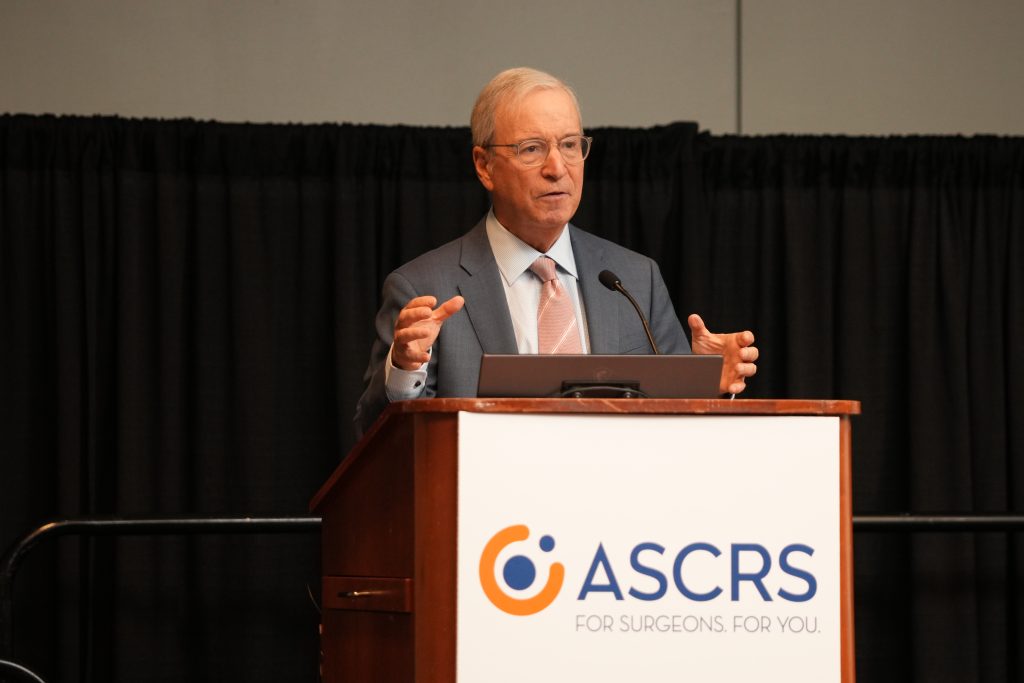
Cecilia S. Lee, MD, addressed how AI could change glaucoma surgery in the future. At present, she said glaucoma patients have a lot of variability in their progression, making it easy to miss those who are rapid progressors and making surgical timing reactive rather than proactive or preventative. AI could help shift this in the future.
Dr. Lee described how she and colleagues trained an AI model to see if it could take a single visual field and predict a patient’s future visual field. The investigators compared nine different deep learning models and saw that they did well. With this research, they found consistent structural and spatial patterns that occur as glaucoma progresses.
Dr. Lee said work has also been done to develop an AI model that will aid physicians in deciding which data point or imaging to trust more over others. They created a policy network model that can decide whether to trust the visual field data or OCT more. “We’re not just trying to predict progression but combine multimodal data the ways clinicians do in clinic,” Dr. Lee said.
What’s exciting about the integration of AI into glaucoma is the ability it has to help discover new, modifiable risk factors for disease development or progression and/or new insights on why people progress the way they do. Dr. Lee said she is also excited about research being done to understand how additional factors outside of the eye, such as environmental and systemic factors, are influencing glaucoma disease development and progression.
“I think big data and AI has a high potential to impact glaucoma management to individualize assessment and prediction so our surgical time becomes preventative and not reactive, but validation will be key,” Dr. Lee said.
Also in the session, Ian F. Pitha, MD, discussed minimally invasive bleb surgeries (MIBS), which he said serve as a middle ground to achieve IOP reduction that approaches that of traditional filtering procedures but with an improved safety profile and a reduced recovery period.
Among these are the Xen45 Gel Stent (AbbVie), which is already approved in the U.S., and the Xen63 Gel Stent (AbbVie), which has the same injector system as the Xen45 but a larger internal lumen diameter, creating less outflow resistance. The Xen63 has the CE Mark but is not yet FDA approved. Dr. Pitha also brought up the PRESERFLO Microshunt (Glaukos), not yet approved in the U.S.; Calibreye Shunt (Myra Vision), a titratable shunt that features nitinol switches that are adjusted in clinic via laser to control outflow and is not yet FDA approved; VisiPlate (Avisi Technologies), an ultrathin, multichannel shunt designed to reduce hypotony and provide outflow redundance, currently enrolling a U.S.-based study; AquaLumen (PLU Ophthalmic), an implant-free MIBS that creates outflow through a sclerotomy and is available in the U.S.; and office-based interventions that create a scleral tunnel connecting the anterior chamber to the subconjunctival space or insert a transconjunctival stent, respectively.
Dr. Pitha discussed current data and techniques for clinical success for each of these MIBS.
While there are many technologies not yet available in the U.S., cataract surgery offers several beneficial upgrades that are available now. Excluding combined phaco-MIGS options from his presentation, because as Reza Alizadeh, MD, said, many presentations would focus on MIGS throughout Glaucoma Day, there are several modern cataract surgery developments that can improve outcomes for glaucoma patients.
One of these is use of the femtosecond laser. This technology creates a precise capsulotomy for better IOL centration, uses less phaco energy, lowers endothelial cell loss, and can create precise corneal incisions for astigmatic correction. These are beneficial for glaucoma patients who have pseudoexfoliation syndrome, who may have a compromised corneal endothelium from long-term medication use, who need reduced inflammation (less steroid use for less of a steroid response), and can provide better outcomes in what can be complex anterior segments.
Dr. Alizadeh also said he uses intraoperative aberrometry often in his glaucoma patients. When it comes to advanced-technology IOLs, multifocal IOLs need to be used with caution, but he sees a value in monofocal IOLs with mini-monovision, EDOF lenses, toric IOLs, and the Light Adjustable Lens (RxSight). EDOF lenses, he expounded, can be options for glaucoma patients with visual field defects; they have reduced glare/halos compared to multifocal IOLs, while improving intermediate vision, maintaining contrast sensitivity, and having a lower risk for positive dysphotopsias. Toric IOLs can benefit glaucoma patients because they need reliable visual field testing, Dr. Alizadeh said. Intraoperative aberrometry can ensure these lenses are placed in their optimal axis.
Other future cataract technologies that could be useful for glaucoma patients are drug-eluting intraocular lenses. SpyGlass Pharma is currently in a Phase 3 clinical trial for one such IOL.
“In a nutshell, if you have a glaucoma patient who has a cataract and is asking for ‘upgraded’ options, you have to make sure they do qualify,” Dr. Alizadeh said. These qualifications include having mild-to-moderate open-angle glaucoma with visually significant cataract, well-controlled IOP on 1–3 medications and seeking a reduction in these medications, commitment to postop care compliance and follow-up, realistic expectations, and no advanced visual field loss.
Other presentations focused on innovations in cyclodestruction, the MIGS pipeline, and how MIGS are approved by the FDA.
Editors’ note: Dr. Pitha has relevant financial disclosures with Hexiris. Dr. Alizadeh and Dr. Lee have no relevant financial disclosures.