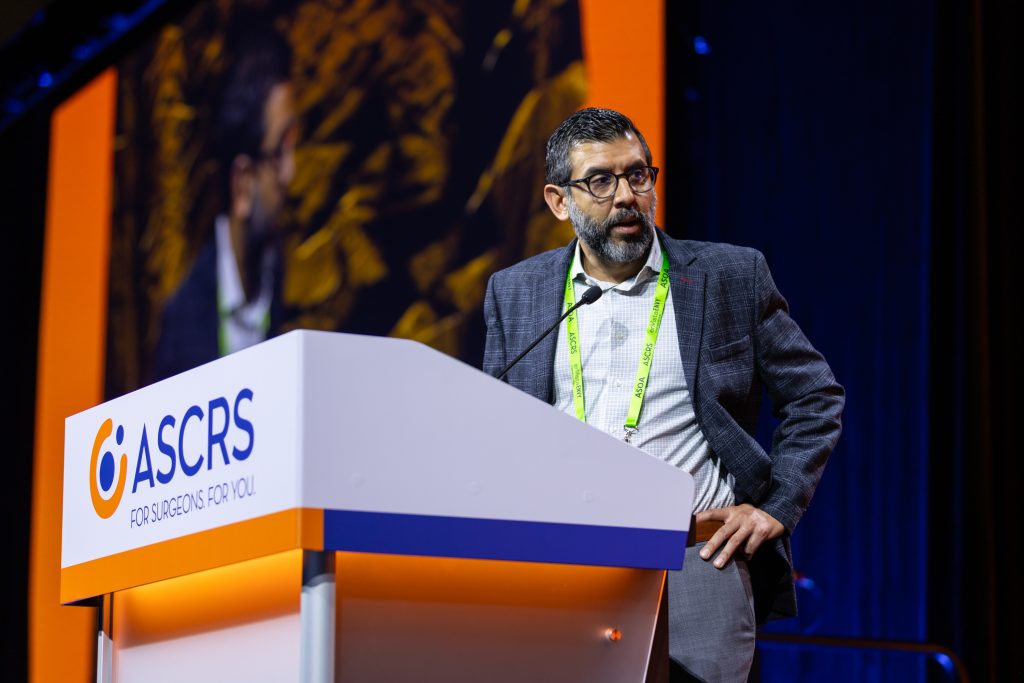
‘Winning Practice Challenge,’ a new feature at SightLine at ASCRS, looked at several ophthalmic practices that are healthy and thriving in today’s environment. Practices were evaluated for clinical excellence and intelligent use of technology, patient experience and culture of care, operational excellence and practice health, team engagement and development, and strategic growth and community impact.
The session was moderated by Vance Thompson, MD, and Carrie Jacobs, COE. Judges in the session were Debbie Davis, COE, Amy Jacobs with Sandbox Strategic, and Bill Rabourn with Medical Consulting Group. Practice presenters in the session were Nicole Fram, MD, Eric Donnenfeld, MD, and Blake Williamson, MD.
It was Dr. Williamson who was this year’s winner. He shared details about his practice, Williamson Eye Center, which is a family practice and has grown from one location to several locations that Dr. Williamson called “one of the largest vertically integrated eyecare systems in Gulf South.” As the practice grew, Dr. Williamson said they had the choice to grow it like a corporation or like a family. They chose the family approach.
“We’re committed to the idea that however big we get, we won’t lose the heart, hospitality, and humanity that built the practice,” he said.
At their practice, Dr. Williamson said patient experience isn’t a department; it’s a clinical strategy. “Our surgeons give out their personal cell phone numbers and call every patient after surgery,” he said, adding that the practice also has a patient experience coordinator.
You can be high volume and also high touch, he said. When people feel cared for, they trust you. “I believe when they trust you, the outcomes are just better.”

Source: ASCRS
Dr. Williamson described his practice culture as a competitive advantage. Additionally, when deciding which technology to incorporate into practice, they ask three questions: 1) What problem does this solve? 2) Is it safe 3) Is it profitable to our business?
He also shared his practice’s approach to train aggressively and noted their fellowship, as well as working with optometrists.
Hospitality is a tool. “We’re not just building a practice, we’re building a place patients feel cared for, staff feels valued, and innovation thrives,” he said.
During the session, Dr. Donnenfeld shared his practice experience, particularly why his practice entered private equity and what was learned.
In 2018, his practice made the shift to private equity for a variety of reasons, including increased complexity in staffing and not wanting to end up working for a hospital or insurance company. We had an entrepreneurial spirit, he said.
Before the move, his practice professionalized their business, improved reporting and productivity metrics, standardized EMR across all practices, and invested in capacity and built infrastructure.
Now after this shift, there is more physician time focused on patient care and surgery, and they are getting better insurance reimbursement (about 20% better than other people in the environment because they deal directly with the insurance companies). His practice made a strategic decision not to do optical, but he said they engage with optometrists.
Dr. Donnenfeld did note some tradeoffs to consider: more accountability, more reporting, and less tolerance for inefficiency, among other things.
Looking at where his practice is headed, Dr. Donnenfeld stressed the importance of recruiting the next generation. He also noted the number of FDA trials and publications his practice participates in. There is a strong emphasis on innovation, research, and new technology. He added that they will likely incorporate more AI in the future, and they want to incorporate more ODs.
In terms of what could have been done better, Dr. Donnenfeld said expansion was greater than operation improvement. Low interest rates fueled aggressive pricing and created debt. He also said the growth story was unrealistic—cataract, premium IOLs, retina, ASC synergy, and refractive upside was perceived as a compounding narrative, beyond reality, which Dr. Donnenfeld said resulted in overpaying for assets.
His take-home message was that ophthalmology is a great specialty, but even a great specialty can be overvalued. That creates opportunity, he said. While Dr. Donnenfeld recognized some problems with private equity today, he thinks it can be a great opportunity for those willing to take a little risk.
When you go to a larger practice, it’s easy to get caught up in letting someone else do things, Dr. Donnenfeld said, but you must maintain culture in the practice. “Without culture, you have nothing.”
Our mission is to enable people to enjoy life more fully through improving and restoring vision, Dr. Donnenfeld said, adding that doesn’t only apply to the patients.
Dr. Fram’s presentation on her practice focused on if a small boutique practice can survive the consolidation of ophthalmology.
She offered 5 steps for success for a small boutique practice to survive:
- Team first: She said this is inspired by Vance Thompson Vision. It includes adjusted schedules, Friday afternoon education, and office outings.
- Start with “the dream” of full range of vision: We used to start with discussing basic surgery, she said, but now start with “the dream.”
- Be state of the art and an early adopter: Dr. Fram said she learned from her former partner Sam Masket, MD, to invest in technology and clinical trials that serve the patient, doctor, industry, and ophthalmology in that order. “This is what I use every day when I’m trying to decide what to invest in,” she said.
- Collaborate, measure, contemplate, and change: It’s important to pivot when something is not working. Build in the time to analyze; measure and benchmark; and watch the money.
- Don’t just take … give back to the community: Dr. Fram noted that she and Dr. Masket founded the Masket Foundation, which provides surgical eyecare for the underserved in the Los Angeles area. She also noted the value she and her practice place on training. It is the most gratifying thing in the world to train forward, she said.
Dr. Fram shared some of the next steps for her practice, including expansion into less congested areas, passive income, and multispecialty likeminded partnership.
So, can a small boutique practice survive consolidation? Dr. Fram said, “Yes!”