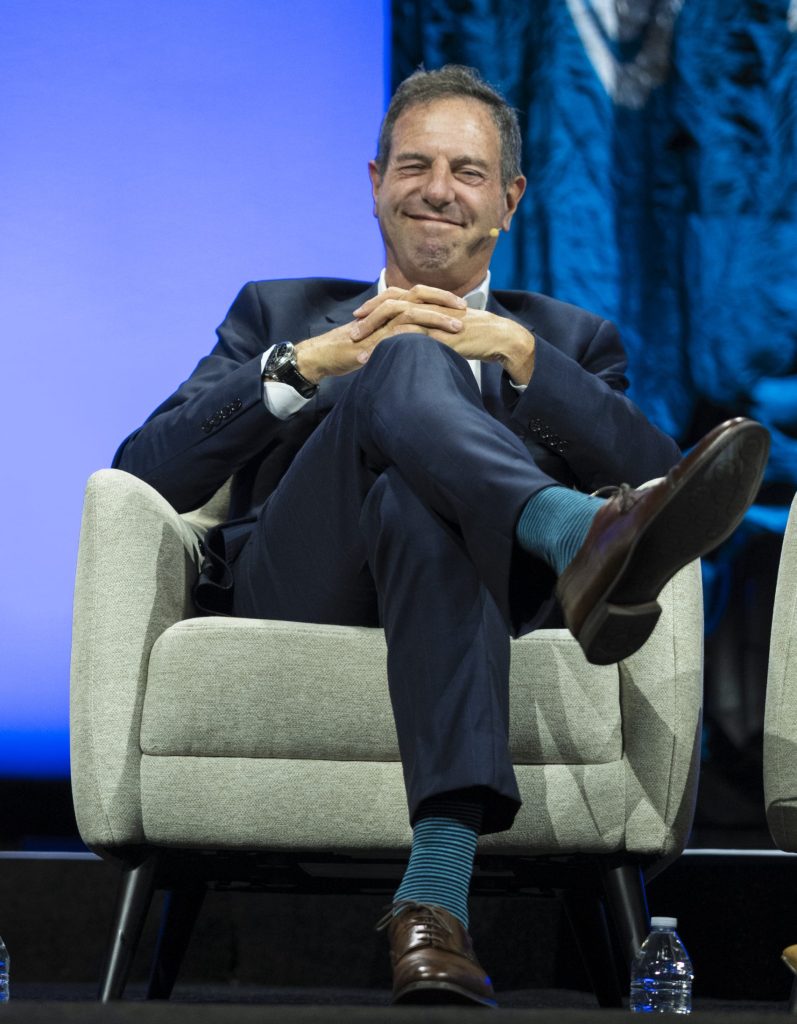
The “Best of Cataract Coach – Learning from Challenging Cases” returned as a symposium at the ASCRS Annual Meeting on Sunday morning, with Uday Devgan, MD, as the moderator and Rosa Braga-Mele, MD, and Deepinder K. Dhaliwal, MD, as panelists.
In this high-energy video session, Dr. Devgan showed dozens of challenging case videos, engaging the audience and the panelists for their perspectives throughout each case.
The first case involved a patient with 2.5 D of cylinder with the rule at 90 degrees. During I/A, though unsure how, Dr. Devgan experienced a posterior capsule rent. “It’s not even a small rent,” he lamented, reiterating this patient’s need for a toric IOL.
What’s your next move? Dr. Dhaliwal said to keep the probe in the eye, inject OVD, and give yourself time to think. If you were to take the probe out first, Dr. Braga-Mele cautioned, it would change the pressure and could cause all the vitreous to come forward.
Dr. Devgan followed Dr. Dhaliwal’s advice and stabilized the chamber. He didn’t think he had vitreous, so he still put in a toric but rotated the lens into the correct axis before the haptics opened. He hydrated the incision and with low parameters gently removed the viscoelastic. “Then Diamox [acetazolamide, Zydus Pharmaceuticals] is your best friend,” he said. Dr. Braga-Mele said she would consider a suture in this case to avoid decompression afterward. In the end, the patient did well, Dr. Devgan said.
Another case performed by a guest surgeon showcased a routine cataract procedure, but when the lens was inserted and the surgeon tried to center it, it wouldn’t maintain centration. “There is something wrong,” Dr. Dhaliwal said, noting that both haptics look like they’re in the bag. “The one thing you’re really afraid of is vitreous prolapse pushing the lens forward.”
This is exactly what was happening. “But when did the bag break?” Dr. Devgan asked. It was such a subtle moment. Dr. Braga-Mele identified that it occurred while taking out the subincisional cortex. There was a moment where everything came up and the bubbles moved to the side—that was the sign.
As the case continued and the surgeon tried to center the lens, Dr. Devgan said you don’t realize how much viscoelastic is trapped in the vitreous. The lens was removed, an anterior vitrectomy performed, and a three-piece lens inserted with optic capture.
“After enlarging the incision,” which occurred when the original IOL was removed, Dr. Devgan said, “I would put a suture in and do a triamcinolone check” for this case.
Three other case videos highlighted hidden retained lens fragments. One case involved a toric lens where Dr. Devgan sensed something was not quite right. Checking around, a whole nuclear piece popped to the forefront. “Where did that come from?” Dr. Devgan said. Dr. Braga-Mele said yellowy-orange irises can hide these pieces. Dr. Devgan went on to check under the iris for other subincisional pieces, performing an angle sweep by injecting balanced salt solution with a 27-gauge needle.
Another case involved an RK eye. The case video began with the lens already in the bag, but Dr. Devgan said something with the iris contour seemed off. He checked around and found a large nuclear piece hiding under the iris. “The only thing I’m going to say is maybe don’t chop your lens into so many little pieces,” Dr. Braga-Mele said.
The third case of retained fragment involved a mid-dilated iris. It’s important to check under the iris in these situations because you’ll be surprised how retained lens pieces are more common than you may think. Signs of retained lens pieces are a visible piece in the inferior angle, chronic inflammation that’s not resolving, a peaked pupil in one area, and ciliary flush/photophobia.
Additionally, a few video cases proved the point of Dr. Devgan’s 7L rule, which he called a “Cataract Coach basic.” One case involved a lens implanted during hydroimplantation, but upon opening, the surgeon noticed that the lens was implanted upside down. The surgeon tried to flip the lens, while open, in the eye.
In these cases, Dr. Devgan said you could leave the lens as is. The effect of an upside down lens could include nothing, a slight hyperopic shift, and/or PCO since you don’t have the posterior square edge of the IOL in the correct orientation to prevent it.
“Would you rather have a scraped endothelium or the lens in the right position?” Dr. Devgan asked rhetorically. Dr. Dhaliwal said the surgeon should “do no harm, that’s the key.” Dr. Braga-Mele said this is why inserting the lens under viscoelastic instead of balanced salt solution can be safer because the lens opens slower and could be flipped in time if the surgeon realized it was in the wrong orientation.
The 7L rule is that the leading haptic should look like the number 7 when coming out of the injector and the trailing haptic looks like an L.
Editors’ note: The physicians have no relevant financial disclosures.