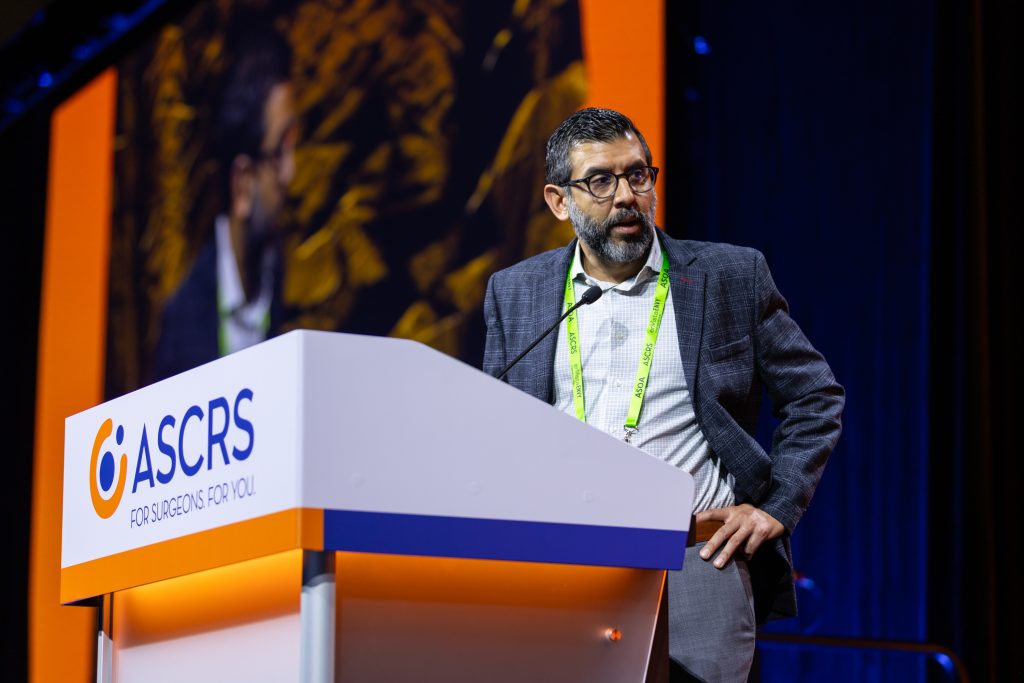
Karolinne Rocha, MD, PhD, and Beeran Meghpara, MD, moderated the second session of Cornea Day, which focused on keratoconus management.
William Trattler, MD, shared some data and take-home messages for epi-on crosslinking, which was approved in 2025. His five take-home messages were:
- Epi-on is superior to epi-off crosslinking: Dr. Trattler said there are less risks and a low chance of needing a second procedure.
- Keratoconus is often progressive: He noted that, even if patients have a history of stability, they can still worsen.
- Regardless of corneal thickness, all can have crosslinking.
- Keratoconus is far more common than most realize in the U.S.: Dr. Trattler said 1–3% of patients undergoing cataract surgery have keratoconus.
- Difference maps are key to determining stability.
Dr. Trattler went on to discuss some of the advantages of epi-on crosslinking, including no epithelial defect, fast visual recovery, virtually no risk of infection, you can perform bilateral procedures, less need for second procedure (this has been around 1%), less discomfort, a bandage contact lens is not needed, it avoids the risk of corneal haze related to epithelial removal, lower risk of inflammatory infiltrates, and reduction in postop visits.
So, how should we define success in crosslinking? Dr. Trattler noted biomechanical stability, maintenance of corneal clarity, and durability of treatment. Epi-on will have all these features. The real question is why would we want to remove the epithelium? Dr. Trattler said that the original formulation of riboflavin was made incorrectly, and you couldn’t effectively penetrate the cornea without removing epithelium.
How important is corneal thickness? The current on-label indication is 325 microns.
Oxygen is a critical component to the crosslinking reaction, and you can use pulsed light or supplemental oxygen. Oxygen depletion within the cornea occurs quickly, Dr. Trattler said, adding that he uses pulsed light for 15 seconds on and 15 seconds off. When you have oxygen, there is a better reaction.
Dr. Trattler also shared data from the recent clinical studies that led to approval of epi-on crosslinking—one that included 280 patients, and one that included more than 300 patients. In addition to showing stabilization and preventing progression, the treatment group did show a little flattening as well.
In Dr. Trattler’s opinion, epi-on will be proven to be superior to epi-off.
Steven Greenstein, MD, presented in the session on determining the best candidates for CTAK, and he shared several key criteria in patient selection. First, he said it works well for patients with irregular astigmatism. He noted Kmax from 50–80 D and BSCVA <20/25. He also said to be more careful with ectasia, and he said that you shouldn’t use it in a cone that extends outside of the central 6 mm optical zone. Avoid scarring in the visual axis.
William Wiley, MD, discussed CTAK, notably the surgical technique and if it should be combined with crosslinking. He noted that combined CTAK and crosslinking sequencing is currently uncharted territory, and prospective data collection is essential.
In the shared mission of eliminating PK, Dr. Wiley said both crosslinking and CTAK serve this overarching goal through different mechanisms. He said the decision of which procedure to use, in which order, or if you can combine the two procedures is driven by BCVA. CTAK first is often preferred, as there is better patient psychology, it avoids post-crosslinking dissection difficulty, and planning accuracy is preserved. He added that systemic data collection will shape the future standard of care, so it’s important to track outcomes.
Editors’ note: Dr. Greenstein has relevant financial disclosures with CorneaGen. Dr. Trattler has relevant financial disclosures with Glaukos. Dr. Wiley has relevant financial disclosures with CorneaGen and Glaukos.