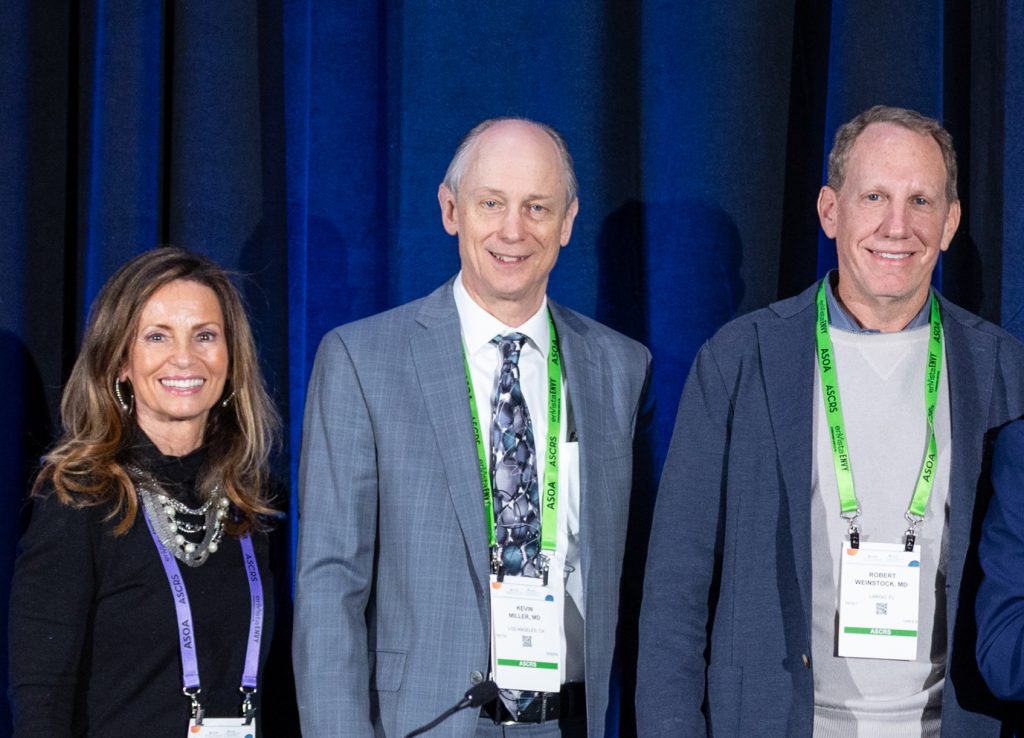
As Kevin M. Miller, MD, prepares to officially take on the role of ASCRS President at the ASCRS Annual Meeting in Washington, D.C., he spoke to EyeWorld about his involvement in the Society and what he’s looking forward to during his tenure.
Focusing on membership and building it across the Society is one of his main goals and initiatives. Across the country, medical societies are seeing dwindling numbers of members, he said, which is largely driven by economics. Dr. Miller plans to put forth a concentrated effort to grow membership to keep the Society functioning and strong.
“If you look at ophthalmology as a specialty, we have the American Academy of Ophthalmology, which represents all of us, and we have different subspecialty societies. Most of the subspecialties have fellowships, but there aren’t any specific fellowships in cataract and refractive surgery. It’s the largest specialty in ophthalmology, but it’s not represented in any fellowship programs,” Dr. Miller said.
Source: ASCRS
In most training programs, cataract training and clinical care are delegated to general or comprehensive ophthalmology, Dr. Miller continued. Refractive surgery is usually associated with the cornea service, although refractive and general cornea care are quite far apart, though they work on the same tissue.
As such, one of Dr. Miller’s goals is to encourage department chairs at academic institutions or division chiefs to think about starting cataract and refractive surgery divisions or services. Cataract and refractive teaching should have a dedicated presence within academic ophthalmology that reflects what we do as ASCRS members, he said, adding that cataract and refractive surgery is just as much a subspecialty as any other.
Dr. Miller noted that a decade ago, a cataract and refractive surgery division was started at UCLA, where he practices. “We’re currently the only one in the country,” Dr. Miller said. This should be something all departments at least think about doing, adding that it would produce a ready pool of future members for ASCRS. When residents and fellows go through such a training activity, becoming a member of ASCRS is a natural next step.
“I’d like to see academic departments create divisions of cataract refractive surgery, and I’d like to see those divisions then create fellowships to train people on the things that we do as a subspecialty society,” Dr. Miller said.
“Finding ways to engage people is also something we’re targeting,” he continued, adding that it will be important to engage ophthalmology department chairs in this effort as well. There’s an opportunity to create something brand new. This is a long-term effort to address ophthalmology training as a whole, he said.
Membership growth will also entail reaching out to other specialty societies, like the Cornea Society and the American Glaucoma Society. “I think we need to do more outreach to these other societies to bring some of their subspecialists on board,” he said.
Dr. Miller is interested in the working relationships between ophthalmologists and optometrists. He acknowledged the concern and caution around scope of practice expansion for optometrists but said that ophthalmologists and optometrists often work closely together and in collaboration in many practices and university systems. He stressed the importance of ophthalmologists and optometrists being on the same page in terms of education and medical management of patients because this can help practices thrive. “I think there’s a responsible way of doing this,” he said, adding that it’s important to keep any education for optometrists non-surgical and within their scope of practice.
Decreasing reimbursement continues to be a concern. “We need to educate ophthalmologists on how to generate revenue in the setting of ever-declining reimbursements from Medicare and private payers because this problem is not going away,” Dr. Miller said. Unless you’re offering premium services, you won’t be able to stay in business, and that’s where something like the ASCRS ASOA Business of Refractive Cataract Surgery (BRiCS) Summit is applicable, he said. He stressed that it’s important for members to realize the value of this offering for their practices and how to implement these services to be able to survive and thrive in the financial climate affecting practices.
Dr. Miller has been involved with ASCRS for many years. He first started attending the Annual Meeting years ago when it took place at the Century Plaza Hotel in Los Angeles, California. As a third-year resident attending his first meeting, Dr. Miller noted the impact of being in the same room as all the “big shots” in ophthalmology, getting to hear their thoughts, and talking with them. “I was inspired by the people I met, and everything was super innovative. I could take things home and immediately start using them,” he said. “Everything was actionable, and that makes an impact on the lives of the patients that we are treating.”
Dr. Miller called the ASCRS Annual Meeting atmosphere “invigorating,” making it a group that he wanted to be a part of. He recalled stepping up to the podium to present a paper for the first time, the “beginning of my ASCRS career.”
Dr. Miller added that for young ophthalmologists, ASCRS provides a platform for showing their research, innovative ideas, and surgical techniques, and they get an audience they can speak to and get immediate feedback from because people in the room are very knowledgeable. “It’s a stimulating environment,” he said. “ASCRS encourages people to come and present—it’s not exclusive. Everyone has an opportunity to get their foot in the door, and others in the Society are very encouraging; it’s a group effort.”
Throughout his career, Dr. Miller has been involved with ASCRS on the Cataract Clinical Committee (including as chair), Skills Transfer Sub-Committee, and with EyeWorld magazine, where he led the Complicated Cataract Cases column for several years. He continued to work within the Society and on programming and was asked to join in a leadership role.
During his presidency, ASCRS will continue in the efforts it’s well known for, such as with EyeSustain and Clinical Committee white papers. “That will never stop. We’ll always be innovating there,” Dr. Miller said. “We’ll also be looking out for new problems, burdensome government regulations, FDA issues, innovative opportunities, etc.”
“Any time something comes up, we’re going to continue to address it as a Society,” he said, again stressing the importance of the Clinical Committees. “We want to encourage people to get involved and get on the committees,” he said. “If you’re young, get on the YES Committee, and you can work your way up.”
Dr. Miller shared what he is most looking forward to at the 2026 ASCRS Annual Meeting, including the official transition to the role of ASCRS President. He also noted a symposium he is moderating, sponsored by ASCRS, ESCRS, and APACRS, that will cover topics in the future of ophthalmology like AI, robotics, and surgical simulation. Dr. Miller has a background as an electrical engineer, so he’s interested in these topics and is also a consultant for a robotics company. “I think there’s a lot of interest and excitement there,” he said.