
A session during ASCRS Refractive Day, April 10, “Legislating Vision – A Disciplined Approach to Pseudophakic (Lenticular) Refractive Surgery,” began with presentations about depth of field IOLs and what’s best for each patient.
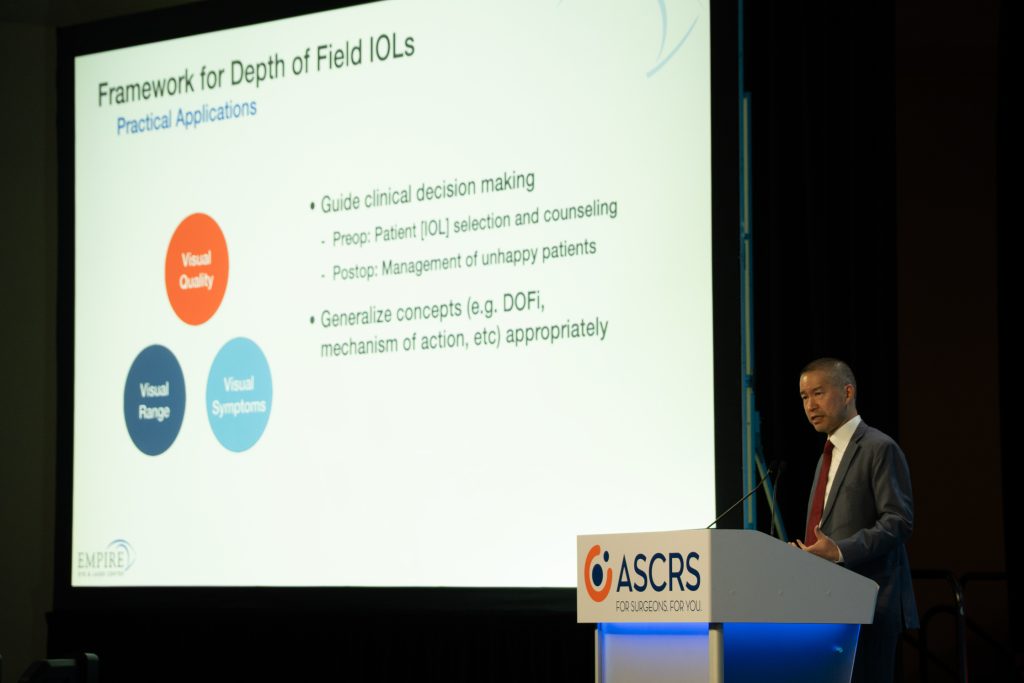
When it comes to presbyopia-correcting IOLs, Daniel Chang, MD, introduced the work of the ASCRS Functional Vision Working Group, which found that there are two categories (accommodating and pseudoaccommodating), but when it comes to the latter (the only ones currently available), they’re talked about in many ways (multifocal, trifocal, advanced-technology, premium, enhanced depth of field, etc.). The working group agreed to break up these lenses with the terms “partial” or “full depth of field lenses”—DOFi IOLs.
Source: ASCRS
When it comes to the terminology framework for describing these lenses, Dr. Chang said there are three interrelated concepts, all centered around contrast sensitivity, that all need to be balanced: visual quality, visual range, and visual symptoms. There is interaction between visual range and visual quality among DOFi IOLs, with the more visual range you give, the more visual quality potentially sacrificed, Dr. Chang said.
With this background, three case studies were presented to discuss the different categories of lenses to see what should be selected based on each patient’s priorities.
John Cason, MD, presented on a patient who wanted vision to match his other eye, which had already received an enhanced monofocal IOL. He prioritized visual quality. This patient was 58 years old, an engineer, and a recreational pilot. He said he didn’t mind wearing glasses.
To match this patient’s expectation for what he already experienced in his other eye, Dr. Cason said he had to “master the simple things,” such as taking precise and repeatable measurements. He used the femtosecond laser to soften the cataract and perform astigmatic correction, and he used his best technique for phaco.
When it came to the IOL, an enhanced monofocal, which doesn’t have an established definition, is somewhere between a monofocal and EDOF, with spherical aberration being used to get a bit more intermediate vision.
The options available in the U.S. for enhanced monofocals are Eyhance (Johnson & Johnson Vision), enVista Aspire (Bausch + Lomb), and the RayOne EMV (Rayner). There are other enhanced monofocal IOLs available outside of the U.S., and Dr. Cason said that the LAL+ (RxSight), which is available in the U.S., could be classified as an enhanced monofocal as well.
Dr. Cason presented several studies that found no significant difference in contrast sensitivity or quality of vision between enhanced monofocal IOLs and monofocal IOLs. Studies that looked at Eyhance, he continued, have shown it can provide an extra line of intermediate and near vision, with these patients being more likely to achieve spectacle independence for intermediate vision compared to monofocal IOLs. He did note, however, a study that found Eyhance to be similar in CDVA and DCIVA when compared to the Clareon monofocal (Alcon).
Sumitra Khandelwal, MD, shared a case of a patient who prioritized full range of vision. This patient was 74 years old and still working part-time as a physician. He complained of progressive blurry vision in both eyes and noted glare and halo at nighttime. He claimed to wear his glasses “all the time.”
Dr. Khandelwal said for myopic patients, such as this one, she carefully asks questions to reveal whether they do in fact take their glasses off sometimes, such as to read up close at night or to look at their phone. Her discussion with the patient revealed that he did take his glasses off for some very near vision reading, which she said necessitated a conversation that his very close near vision might get worse with surgery.
The full range of vision options for this patient included the PanOptix Pro (Alcon), the enVista Envy (Bausch + Lomb), and the FineVision HP (BVI Medical). She also noted the Tecnis Odyssey (Johnson & Johnson Vision), which is a hybrid design, and the Clearview 3 (Lenstec), which Dr. Khandelwal described as a segmented multifocal lens with different properties as far as optics.
“Whenever you’re going to use one of these lenses, you should look at defocus curves,” she said, noting if you look closely at these curves you find they’re not full range of vision but have some peaks and troughs.
Dr. Khandelwal summarized that all of these lenses provide good distance vision, but dysphotopsias must be considered and the tradeoffs discussed with the patient.
The final case presentation was for a patient who prioritized minimization of visual symptoms/dysphotopsias. This patient was a 57-year-old commercial airline pilot who wanted spectacle independence. Daniel Black, MD, who presented the case, said the patient had mild tear film instability and mild hypoxia due to his working conditions.
He discussed this patient’s options for partial depth of focus lenses that could deliver more spectacle independence while minimizing visual symptoms. One was Tecnis Symfony (Johnson & Johnson Vision), which is a diffractive IOL with achromatic technology that can correct chromatic aberration to improve image quality. One study found that a third of patients with this lens experienced significant dysphotopsias, which Dr. Black said was not unexpected of a diffractive technology.
In a study involving the AcrySof Vivity (Alcon), Dr. Black said, 3.7% of patients were dissatisfied due to visual symptoms, but a study of the same lens on the newer Clareon platform showed no contrast sensitivity issues or severe photic phenomena.
The IC-8 Apthera (Bausch + Lomb) is another option for a patient with similar desires, but Dr. Black noted that there is a drop in contrast sensitivity in low light conditions, while there is not a significant increase in dysphotopsias.
Finally, the Tecnis PureSee (Johnson & Johnson Vision) has been found to preserve contrast sensitivity with and without glare, similar to that of a monofocal IOL, Dr. Black said. With this, Dr. Black found the PureSee to be the best option for this patient who required good scotopic contrast and minimal dysphotopsias.
The session continued with presentations on refractive lens exchange; how to balance visual quality, range of vision, and visual symptoms in diseased eyes; the impact of refractive error on visual quality and visual symptoms; and postop management of patients with depth of field IOLs.
Editors’ note: Dr. Chang has relevant financial disclosures with various ophthalmic companies. Dr. Black has relevant financial disclosures with Johnson & Johnson Vision. Dr. Khandelwal has relevant financial disclosures with Bausch + Lomb, Johnson & Johnson Vision, and Zeiss. Dr. Cason has relevant financial disclosures with Zeiss.