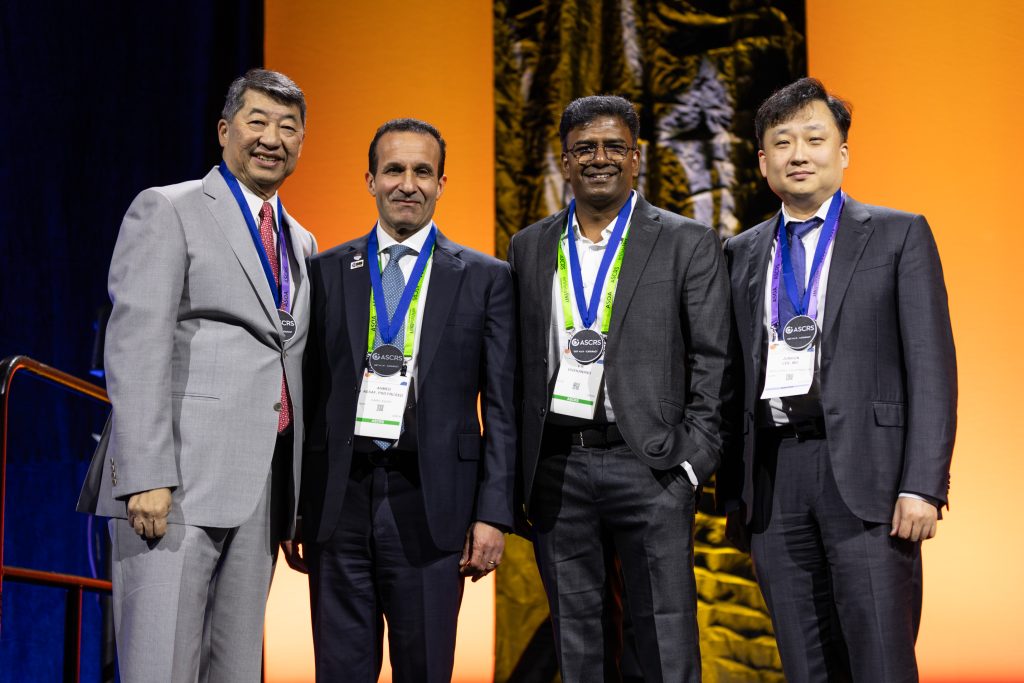
Ronald Krueger, MD, delivered the Steinert Lecture during ASCRS Refractive Day on Friday, April 25, focusing on the history and innovation of the lasers for refractive surgery, his involvement with some of this innovation, and his mentors along the way.
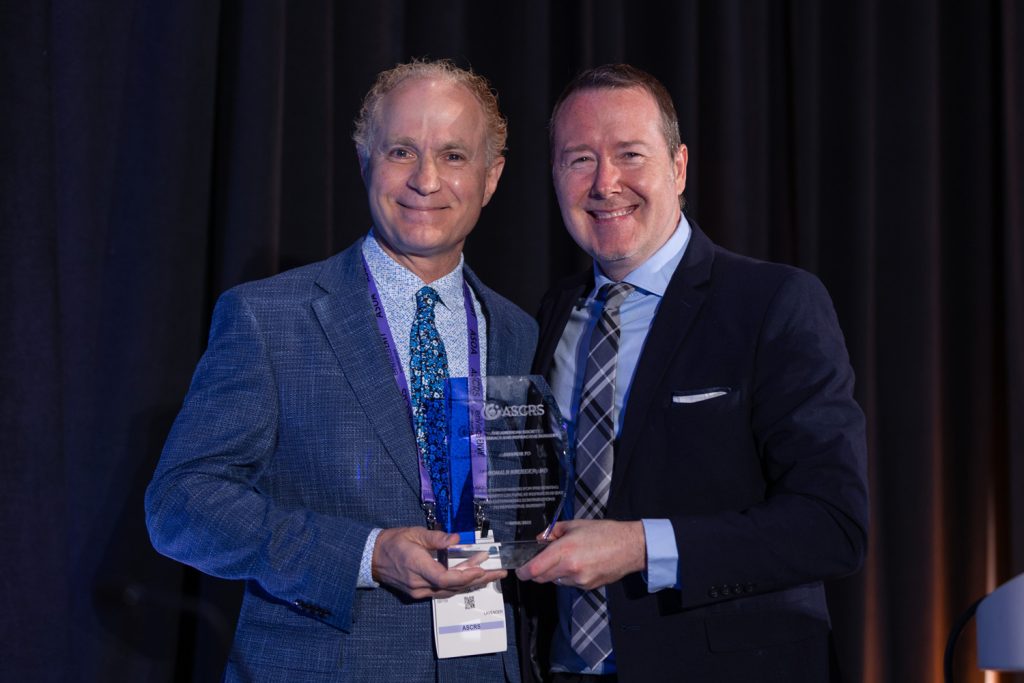
George Waring IV, MD, introducing Dr. Krueger and the Steinert Lecture, said Dr. Krueger was involved with the early work developing and advancing the excimer laser, which made LASIK possible, and he helped popularize the idea of international fellowships.
Source: ASCRS
“To know Ron is to love Ron. We’re so thankful to have had a lifetime of support, friendship, and mentorship by Ron,” he said.
Both Dr. Krueger and Dr. Steinert “shaped the way we think, challenged the way we think, and like many great leaders, they are gentle giants in our field who have never been afraid to ask why,” Dr. Waring said.
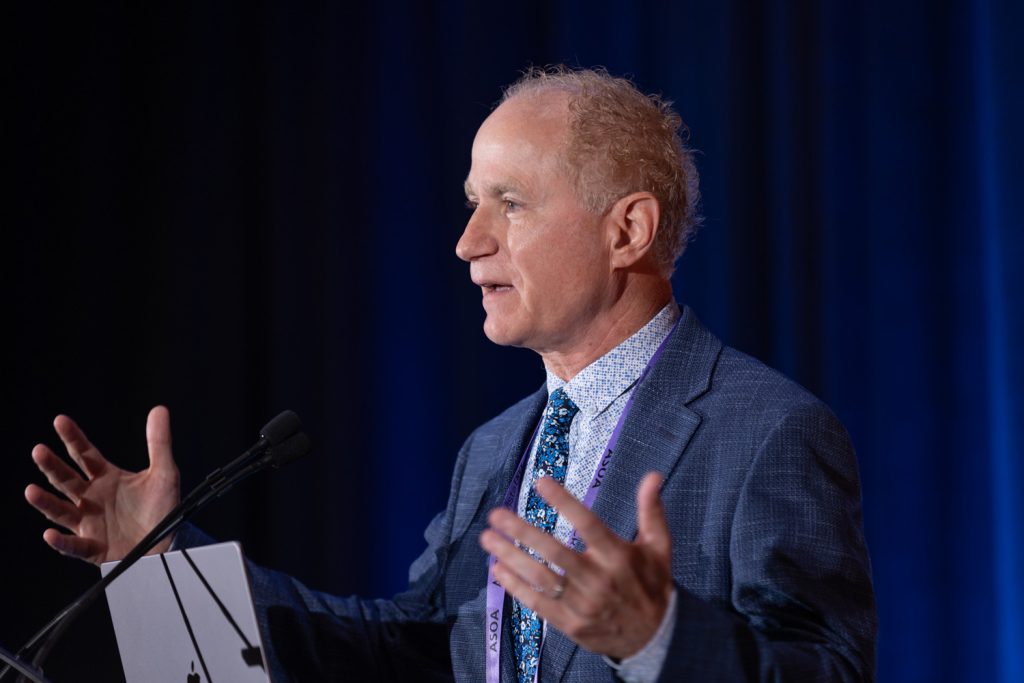
In his lecture, Dr. Krueger invited the audience to step into his time machine. Like the flux capacitator in the movie Back to the Future (the theme of the 2025 Refractive Day), Dr. Krueger took a look at the evolution of three lasers: excimer, femtosecond, and Ho:YAG.
Excimer laser
Dr. Krueger said Steve Trokel, MD, first published on excimer laser surgery of the cornea in 1983. When Dr. Krueger was a first-year medical student, months after the article was published, he began working in Dr. Trokel’s lab. “It was exciting to be mentored by Steve Trokel at that period of time,” he said.
He explained that the excimer laser was a cold laser with the ability to break bonds without heat, and they discovered at 193 nm a pseudomembrane developed that served as a scaffold for the epithelium to grow across. “This made possible something that was never done before: surgical alteration of the center of the cornea without getting a scar,” he said, calling this a paradigm shift, paving the way for laser vision correction.
Two years after working with Dr. Trokel, Dr. Krueger did a 3-month rotation with Dr. Steinert in his laser research lab where they took high-speed photographs of excimer laser ablations.
In 1986, the first international workshop on corneal laser surgery was held, and the first clinical PRK was performed by Theo Seiler, MD, PhD, in Germany.
In the time that followed, Dr. Krueger said the field learned astigmatism could be treated, that there was a limit to PRK ablations (if you treat too much myopia, you could get haze, scarring, and regression), and customized treatments were developed. LASIK was approved in 1997, followed by customized LASIK in 1999, wavefront LASIK in 2002, optimized LASIK in 2005, and topography-guided LASIK in 2016.
Just a month ago, ray trace LASIK was approved, combining wavefront, tomography, and biometry in one device, increasing the speed of planning with a 3D model of the eye, and with “really good quality outcomes,” Dr. Krueger said.
Source: ASCRS
Femtosecond laser
Dr. Krueger took attendees back to 1995 for the next energy source, starting with the picosecond laser for photodisruption, the precursor of the femtosecond laser.
He said they discovered that the picosecond laser wasn’t really creating ablations inside the cornea but rather photodisruptions, making it a good cutting tool. By 2002–03, the femtosecond laser had revolutionized precision of making flaps for LASIK, and 2009 was the advent of SMILE internationally (it would be approved in the U.S. in 2016). Dr. Krueger said the field has moved from calling small incision lenticule extraction SMILE, which is a product name, giving the category of refractive lenticule extraction the name KLEx, which he said would grow as a category with the uptick of other platforms.
Ho:YAG
This technology performed thermokeratoplasty, which was approved in 2000 as a form of hyperopia correction. Dr. Krueger said the concept was to shrink and soften collagen to change its shape but not denature it. He explained that it was so highly absorbed and you had to crank up the energy to get an effect that it did end up causing denaturation, and failure occurred due to regression. The concept failed but the research with the laser continued.
Dr. Krueger said in 2008, research was being done to treat the sclera with this technology to treat dynamic refractive error, like presbyopia. He described laser sclerociliary translocation (LST) that could cause shrinkage of the sclera over the ciliary body, translocating the ciliary body outward and backward to increase zonular tension, and softening of the sclera over the zonules to increase their compliance and mobility to free ciliary body movement inward and forward.
The future
What’s the next technology? Dr. Krueger spoke about acoustic pressure waves: extracorporeal shock wave therapy. This technology, he said, can soften hardened tissues. “The lens and sclera get hard over time. Could we use this?”
Dr. Krueger said this technology has been used on kidney stones for decades. He said there are many areas within ophthalmology that could benefit from researching use of shockwaves, but he focused on opportunities for presbyopia and cataract reversal.
Called micro-shock wave therapy, Dr. Krueger said it increases lens compliance by disaggregating compacted fibers and reduces lens volume via syneresis. He envisioned a time when we might be able to use this type of technology to annually treat presbyopia to restore accommodation, reduce lens volume/compaction, restrict lens fiber degradation, and retard cataract progression. This has been researched on porcine tissues so far.
Dr. Krueger looked 50 years in the future. He said in 50 years, we might see augmented reality without a headset, AI-based robotic eye surgeries, remote eye surgery, and (to chuckles among those in the audience) named lectures being delivered by a robotic avatar.
Financial disclosures
Krueger: Alcon, Senogen